Showing posts with label garden tips. Show all posts
Showing posts with label garden tips. Show all posts
Tuesday, May 25, 2010


Monday, May 03, 2010
quote Wisdom
"It is a great joy the day we discover that we can learn things without having to make the mistake ourselves."
- Henry Mitchell
- Henry Mitchell
Monday, March 23, 2009
exploring the disconnect
This is part one of three. I've subscribed to Cooking Up A Story who posted this interview. Here's how:
Click on the video to go to the video on YouTube, then hit the subscribe button. YouTube will send you updates in your e-mailbox weekly or however you decide. A great way to keep up with the things you care about.
Sunday, March 22, 2009
I love free samples
Have you read Tina Sams' The Essential Herbal magazine? or followed her blog or visited the Yahoo group she organized? You should check it out - Tina, and by extension her family, are manifesting a herbal life - and she shares the fun (and education) with a journalist's flare for 'writing the life'. The following was in my Google Reader this morning - a free sample of The Essential Herbal Victory Garden edition to download (from a year ago). I suggest Tina send a copy to the Obamas!

Tina wrote:
Free Issue of The Essential Herbal to Download
from The Essential Herbal Blog by Tina Sams
Last year at this time we did an issue that was devoted to the need to scale back, plant a garden, reduce, reuse, and recycle. The cover is a collage of posters from the Victory Garden campaigns of the 1940's. The issue is sold out, and now these topics are getting huge coverage. We were just a little too early.
So - we'd like you to download it and enjoy it. The link is:
http://www.essentialherbal.com/MarchApril2008forweb.pdf
Share it. Forward the link. Send it to your friends, and post it on the lists and forums you participate in. Post it to your own blog and share it with your readers. Help us spread this issue far and wide!
Happy Spring!

Tina wrote:
Free Issue of The Essential Herbal to Download
from The Essential Herbal Blog by Tina Sams
Last year at this time we did an issue that was devoted to the need to scale back, plant a garden, reduce, reuse, and recycle. The cover is a collage of posters from the Victory Garden campaigns of the 1940's. The issue is sold out, and now these topics are getting huge coverage. We were just a little too early.
So - we'd like you to download it and enjoy it. The link is:
http://www.essentialherbal.com/MarchApril2008forweb.pdf
Share it. Forward the link. Send it to your friends, and post it on the lists and forums you participate in. Post it to your own blog and share it with your readers. Help us spread this issue far and wide!
Happy Spring!
Thursday, February 05, 2009
A helpful tip or 2 about recycled blinds plant markers
They do work well, although they are ugly.
But they do fade, sometimes completely, and I've tried everything to keep them going through a single season - ballpoint pen, number 2 pencil, Sharpies, china marking pencil, and so on.
Two hints that work for me:
1. You have a lot of blind to work with from one set, so don't be stingy. Cut them longish (one end flat, one pointy to make digging it in easy) and write the name and variety twice. Bury one labeled end in the soil and the sun and weather won't fade it.
When you need to determine what pepper you're harvesting in October, you won't have to guess, just pull out the label and put it in the same bag as your harvested produce.
2. Since sun fades your tags, be wise when you set them - face the labelled side to the north - the shady side. Works for me.
I wish I was a better photographer, my blog would be much more fun. But who takes pictures of faded plant tags made out of old Venetian blinds?
But they do fade, sometimes completely, and I've tried everything to keep them going through a single season - ballpoint pen, number 2 pencil, Sharpies, china marking pencil, and so on.
Two hints that work for me:
1. You have a lot of blind to work with from one set, so don't be stingy. Cut them longish (one end flat, one pointy to make digging it in easy) and write the name and variety twice. Bury one labeled end in the soil and the sun and weather won't fade it.
When you need to determine what pepper you're harvesting in October, you won't have to guess, just pull out the label and put it in the same bag as your harvested produce.
2. Since sun fades your tags, be wise when you set them - face the labelled side to the north - the shady side. Works for me.
I wish I was a better photographer, my blog would be much more fun. But who takes pictures of faded plant tags made out of old Venetian blinds?
Monday, December 08, 2008
A winter's tale
Victory gardens! The basic sustainable living idea whose time has come again, I'd say. I borrowed this historically relevant video circa 1943 from City Farmer to share with you. Click on the links to see all of City Farmer's videos.
Watch 1943 - You Cannot Eat Lilies - Victory Garden Video in How to Videos | View More Free Videos Online at Veoh.com
Watch 1943 - You Cannot Eat Lilies - Victory Garden Video in How to Videos | View More Free Videos Online at Veoh.com
Tuesday, January 15, 2008
Learn from an expert
I'm planning on taking this series of workshops:
Learn as You Grow:
A Practical Experience in Organic Gardening
Continuing Hands-On Workshops throughout the Growing Season
at Whetham Organic Farm
Gardening is a rewarding hobby for many people throughout the country. It relaxes us, brings us closer to nature, improves our health in many ways. Vegetable gardening also allows us to eat the freshest food possible - from garden to table as it has been done for millenia by people all around the world. But not everyone is confident in their ability to bring real food to their table or to do it in a way that is environmentally beneficial as well as healthful to them. Gardening organically is proven to be ecologically sustainable and to provide food that is more nutritious.
This series of workshops on our farm is designed to teach the philosophy and principles of organic growing to beginning gardeners and those who want to convert to organic practices. These classes will begin in late winter and continue through the season. In spring and summer the sessions will take place in the hoophouse and the garden, providing the hands-on experience needed for practical application of the information.
Participants will learn how to choose varieties and seeds; the importance of soil tests and the minerals needed to increase the fertility of your garden; how to start transplants (in seeds flats and plugs and in soil blocks) and how to transplant. All will be able to take home vegetable plants for your garden. Later in the season participants will actually work in the gardens on our farm, learning when and how to plant seeds and transplants, how to choose cover crops for summer and fall and how to compost.
Workshops will begin in late winter (February) and will continue through October. Ten sessions are planned with each session 2 to 3 hours in length. The cost to attend the entire series is $150. Individual workshops will be $25. Space is limited .
Pat Whetham has 30+ years experience with organic vegetable gardening, including 19 years on a certified organic farm.
This series of workshops focuses entirely on vegetables and herbs and will not cover flowers or ornamentals except as the same techniques apply. Fruit trees will not be covered at all but some of the information can be applied to small fruits such as strawberries.
Contact Pat at Whetham Organic Farm for details: miorganic@aol.com or 810-659-8414 or reserve your spot in the workshops by sending in the form below with a $25 deposit. Send to Pat Whetham, Whetham Organic Farm, 11230 W. Mt. Morris Rd, Flushing MI 48433.
Learn as You Grow:
A Practical Experience in Organic Gardening
Continuing Hands-On Workshops throughout the Growing Season
at Whetham Organic Farm
Gardening is a rewarding hobby for many people throughout the country. It relaxes us, brings us closer to nature, improves our health in many ways. Vegetable gardening also allows us to eat the freshest food possible - from garden to table as it has been done for millenia by people all around the world. But not everyone is confident in their ability to bring real food to their table or to do it in a way that is environmentally beneficial as well as healthful to them. Gardening organically is proven to be ecologically sustainable and to provide food that is more nutritious.
This series of workshops on our farm is designed to teach the philosophy and principles of organic growing to beginning gardeners and those who want to convert to organic practices. These classes will begin in late winter and continue through the season. In spring and summer the sessions will take place in the hoophouse and the garden, providing the hands-on experience needed for practical application of the information.
Participants will learn how to choose varieties and seeds; the importance of soil tests and the minerals needed to increase the fertility of your garden; how to start transplants (in seeds flats and plugs and in soil blocks) and how to transplant. All will be able to take home vegetable plants for your garden. Later in the season participants will actually work in the gardens on our farm, learning when and how to plant seeds and transplants, how to choose cover crops for summer and fall and how to compost.
Workshops will begin in late winter (February) and will continue through October. Ten sessions are planned with each session 2 to 3 hours in length. The cost to attend the entire series is $150. Individual workshops will be $25. Space is limited .
Pat Whetham has 30+ years experience with organic vegetable gardening, including 19 years on a certified organic farm.
This series of workshops focuses entirely on vegetables and herbs and will not cover flowers or ornamentals except as the same techniques apply. Fruit trees will not be covered at all but some of the information can be applied to small fruits such as strawberries.
Contact Pat at Whetham Organic Farm for details: miorganic@aol.com or 810-659-8414 or reserve your spot in the workshops by sending in the form below with a $25 deposit. Send to Pat Whetham, Whetham Organic Farm, 11230 W. Mt. Morris Rd, Flushing MI 48433.
Tuesday, February 27, 2007
Fun with earphones
Susan Wittig Albert has always been a good read, but today I ran across her podcast page. Click the link here.
I listen to .mp3s while gardening... here's a hint: run the wire to your earphones from your belt up UNDER your shirt. It saves on the wire getting caught on, say, a rose bush, or clipped by, say, an errant pruner.
Susan's promised us ten podcasts about ten herbs ... and from there, who knows? Enjoy!
I listen to .mp3s while gardening... here's a hint: run the wire to your earphones from your belt up UNDER your shirt. It saves on the wire getting caught on, say, a rose bush, or clipped by, say, an errant pruner.
Susan's promised us ten podcasts about ten herbs ... and from there, who knows? Enjoy!
Sunday, January 21, 2007
CSI: In My Garden
The January Herb Study at the GCHS was Echinacea.
To paraphrase an old television drama "There are a million stories in the" ...garden... "here is one of them..."
A few years ago I began to notice some significant problem with my purple coneflowers. What! Nothing bothers purple coneflowers! Right!?!
BUT, if something is gonna happen in way of a garden disaster large or small, it'll happen to me.
On closer inspection of my blighted flowers, all of the the ruined cones seemed to be damaged in the same way... blackened broken centers. I cut off the worst flowers and brought them indoors and dissected them on my kitchen counter. Eyuck, small wormy creatures had burrowed straight down from the tip of the seedhead right down into the stem. I took some photos with my first generation digital camera and went out to the garden and deadheaded all of my Echinacea. Dejectedly. I love purple coneflowers.
I couldn't find any clue in my books, or the books at the Extension, or
online, or by asking around. Closest I could figure was a hint from several online sources that certain flowers attract the European Corn Borer, the timing was right, and the damage was identical. It fit the profile of a native plant being decimated by an imported pest, especially because the pest was probably under pressure from all of the cornfields that have surrounded my neighborhood being bulldozed for new subdivisions. But I was still unsettled about it. The little larvae I had didn't look right, I was seeing stripes and the ECB is spotted. I knew from my time working with the Diagnostic team that the distinction was important. All burrowing larvae are not the same.
I even asked flower experts at conferences. Apparently I didn't paint a grim enough portrait of the damage these flowers were suffering. No one knew or cared. Years passed. I deadheaded as needed, dejectedly.
January 2007, the Genesee County Herb Society's herb study will be Echinacea. It's January, time to read with a purpose! Looking through my coneflower photos from years past, the CSI photos sparked my interest in finding the name of that little grub.
I Googled around and came across a paragraph in a paper I downloaded from the Connecticut Agricultural Experiment Station, entitled Perennial Medicinal Herb Trials 1996-1999. On page 7, under Echinacea purpurea L. Moench. is this sentence:
"Echinacea is a member of the aster family, and susceptible to the same insects. Sunflower moth larvae damaged more than 80% of blooms cut in late summer."
Googling furiously, I brought up: "Sunflower Moth" page 3 on a publication from the Maryland Cooperative Extension with a GREAT PHOTO!
Success!
Identification of a pest is the first step in IPM. I feel much better.
Now I have to figure out how to save my purple coneflowers from this particular larvae.
NOTE: Cross-posted to The Backyard Herbalist
To paraphrase an old television drama "There are a million stories in the" ...garden... "here is one of them..."
A few years ago I began to notice some significant problem with my purple coneflowers. What! Nothing bothers purple coneflowers! Right!?!
BUT, if something is gonna happen in way of a garden disaster large or small, it'll happen to me.
On closer inspection of my blighted flowers, all of the the ruined cones seemed to be damaged in the same way... blackened broken centers. I cut off the worst flowers and brought them indoors and dissected them on my kitchen counter. Eyuck, small wormy creatures had burrowed straight down from the tip of the seedhead right down into the stem. I took some photos with my first generation digital camera and went out to the garden and deadheaded all of my Echinacea. Dejectedly. I love purple coneflowers.

I couldn't find any clue in my books, or the books at the Extension, or
online, or by asking around. Closest I could figure was a hint from several online sources that certain flowers attract the European Corn Borer, the timing was right, and the damage was identical. It fit the profile of a native plant being decimated by an imported pest, especially because the pest was probably under pressure from all of the cornfields that have surrounded my neighborhood being bulldozed for new subdivisions. But I was still unsettled about it. The little larvae I had didn't look right, I was seeing stripes and the ECB is spotted. I knew from my time working with the Diagnostic team that the distinction was important. All burrowing larvae are not the same.
I even asked flower experts at conferences. Apparently I didn't paint a grim enough portrait of the damage these flowers were suffering. No one knew or cared. Years passed. I deadheaded as needed, dejectedly.
January 2007, the Genesee County Herb Society's herb study will be Echinacea. It's January, time to read with a purpose! Looking through my coneflower photos from years past, the CSI photos sparked my interest in finding the name of that little grub.
I Googled around and came across a paragraph in a paper I downloaded from the Connecticut Agricultural Experiment Station, entitled Perennial Medicinal Herb Trials 1996-1999. On page 7, under Echinacea purpurea L. Moench. is this sentence:
"Echinacea is a member of the aster family, and susceptible to the same insects. Sunflower moth larvae damaged more than 80% of blooms cut in late summer."
Googling furiously, I brought up: "Sunflower Moth" page 3 on a publication from the Maryland Cooperative Extension with a GREAT PHOTO!
Success!
Identification of a pest is the first step in IPM. I feel much better.
Now I have to figure out how to save my purple coneflowers from this particular larvae.
NOTE: Cross-posted to The Backyard Herbalist
Thursday, May 04, 2006
Organic Gardening Tips
Brother Placid's Tips for Beginning Organic Gardeners
by Emily Gatch
From Seeds of Change
I finally have what I consider a suitable response to the good people who call us at the Research Farm and say, "I want to garden organically. Where do I start?" My response comes in a format that I hope will prove memorable to you: a glimpse into the life and garden of a masterly Master Gardener, Brother Placid of New Melleray Abbey.
I'd like you to take a look with me at an organic vegetable garden on the edge of the prairie in eastern Iowa.
Brother Placid operates the twelve acre organic garden at New Melleray, a Trappist monastery and certified organic beef cattle farm near Dubuque, Iowa that was founded 150 years ago by monks from Mount Melleray, Ireland. Brother Placid's garden feeds not only his community of Cistercian monks of the Strict Observance but the year-round visitors to the monastery's guesthouse as well. His credentials and history as a gardener command rapt attention. He is one of fifteen children born to a Polish farming family in northern Minnesota. He had a reputation among his brothers and sisters as his mother's favorite, a status he attributes to his willingness to spend long hours helping her weed in the vegetable garden. At the age of eleven, during the height of the Great Depression, Brother Placid left home to work on the threshing crews that followed the grain harvest north along the Red River valley. He hopped freight trains out West and worked in the orchards of Washington state as an "apple knocker", dug potatoes in the Oregon's Klamath Valley, picked peaches and harvested vegetable crops in the Willamette Valley, and then moved down into California's central valley working the rice, cotton, and olive harvests. After serving in the army during World War II, he joined the monks at New Melleray and has been there ever since.
A brief look at Brother Placid's garden. He divides the twelve acres into three sections, rotated in the following manner:
One third of the garden is planted each year in alfalfa, which he mows three times over the summer and then turns under in the fall. The following spring, that section is planted in sweet corn, a nutrient-hungry crop that benefits from the 125 pounds of nitrogen fixed by the alfalfa. The remaining third is devoted to innumerable varieties of tomatoes, melons, squash, cucumbers, spinach, beets, turnips, potatoes, and his beloved grapes and berries.
Here are a few of Brother Placid's tips for beginning organic gardeners:
Feed the soil, not the plants. This is the dogmatic theology of organic agriculture. If you are just starting out with a barren plot of ground, devote one year to growing nothing but green manures: quick-growing clovers, oats, and annual grasses that are successively tilled into the soil. By planting and tilling under four different green manure crops and adding old chicken manure and rotting alfalfa bales, Brother Placid was able to increase the organic matter content of a plot of land from less than 1% to 18%. Brother Placid also adds fish emulsion and kelp meal to the furrow before planting to create a nutrient-rich environment for developing seedlings.
Vigilance is the best form of pest control. Be in your garden every day, and be watchful. Brother Placid controls Colorado potato beetles on his potatoes by beginning to scout when the plants reach 12 to 14 inches high, and simply picking the bugs off and squashing them by hand.
Learn the secrets of companion planting. The mutually beneficial relationships among certain crops can result in reduced pest problems and increased yields. Brother Placid interplants radishes with his melons, since radishes are known to deter cucumber beetles. He also recommends cosmos flowers for attracting pollinators to the garden.
Welcome the snow, and use it to your advantage. Snow (as well as collected rainwater) contains small amounts of dissolved nitrates and is "soft," unlike well or city water, which often contains dissolved salts and minerals that leave unwanted residues on plant surfaces. Brother Placid opens his cold frames to allow the snow in, and even shovels it into his greenhouse in the winter!
Compost, both the noun and the verb. Brother Placid is lucky to have plentiful raw ingredients for his compost pile in the green refuse that comes from the monastery and guesthouse's vegetarian kitchen, to which he adds oak leaves, pine needles, and old hay and straw. He typically adds about twelve tons of compost to his garden each year. He warns vehemently against using walnut leaves or chips as a compost ingredient or soil amendment, noting that a previous gardener once added walnut chips to his soil and he is still observing, many years later, some localized detrimental effects of the allelopathic compounds present in walnut trees.
Balanced mulching.While surface mulching generally helps to reduce weed pressure and lower disease incidence in the vegetable garden, Brother Placid has found that straw or chip-based mulches invite mice and voles to take up residence in his garden, so he limits his use of mulch to the one acre asparagus patch and to his berries. Evaluate your varmint situation and adjust your use of mulch accordingly, or experiment with less rodent-friendly mulches such as biodegradable landscape fabrics.
Water wisely.Drip irrigation is a much-preferred method of supplying water to plants, since the moisture left on leaves from overhead sprinkling can lead to foliar diseases.
Remember that gardening is hard work, but good work. Brother Placid likes to think of the story of Adam and Eve, and what they were told when they were expelled from the Garden of Eden: "With suffering you shall get your food from the soil, every day of your life… it shall yield you brambles and thistles, and you shall eat wild plants. With sweat on your brow shall you eat your bread, until you return to the soil, as you were taken from it." He smiles as he thinks of this Genesis passage in the heat of the Iowa summer, knowing that he is doing God's work.
I hope you also find in these words not a message of gloom but a glorious invitation to get out in the garden and get moving. Thank you, Brother Placid, for sharing your infectious enthusiasm and wisdom with me on this Sunday morning in March, and blessings to all you gardeners as you begin a new season.
Emily Gatch
Greenhouse Coordinator and Assistant Seed Cleaner
by Emily Gatch
From Seeds of Change
I finally have what I consider a suitable response to the good people who call us at the Research Farm and say, "I want to garden organically. Where do I start?" My response comes in a format that I hope will prove memorable to you: a glimpse into the life and garden of a masterly Master Gardener, Brother Placid of New Melleray Abbey.
I'd like you to take a look with me at an organic vegetable garden on the edge of the prairie in eastern Iowa.
Brother Placid operates the twelve acre organic garden at New Melleray, a Trappist monastery and certified organic beef cattle farm near Dubuque, Iowa that was founded 150 years ago by monks from Mount Melleray, Ireland. Brother Placid's garden feeds not only his community of Cistercian monks of the Strict Observance but the year-round visitors to the monastery's guesthouse as well. His credentials and history as a gardener command rapt attention. He is one of fifteen children born to a Polish farming family in northern Minnesota. He had a reputation among his brothers and sisters as his mother's favorite, a status he attributes to his willingness to spend long hours helping her weed in the vegetable garden. At the age of eleven, during the height of the Great Depression, Brother Placid left home to work on the threshing crews that followed the grain harvest north along the Red River valley. He hopped freight trains out West and worked in the orchards of Washington state as an "apple knocker", dug potatoes in the Oregon's Klamath Valley, picked peaches and harvested vegetable crops in the Willamette Valley, and then moved down into California's central valley working the rice, cotton, and olive harvests. After serving in the army during World War II, he joined the monks at New Melleray and has been there ever since.
A brief look at Brother Placid's garden. He divides the twelve acres into three sections, rotated in the following manner:
One third of the garden is planted each year in alfalfa, which he mows three times over the summer and then turns under in the fall. The following spring, that section is planted in sweet corn, a nutrient-hungry crop that benefits from the 125 pounds of nitrogen fixed by the alfalfa. The remaining third is devoted to innumerable varieties of tomatoes, melons, squash, cucumbers, spinach, beets, turnips, potatoes, and his beloved grapes and berries.
Here are a few of Brother Placid's tips for beginning organic gardeners:
Feed the soil, not the plants. This is the dogmatic theology of organic agriculture. If you are just starting out with a barren plot of ground, devote one year to growing nothing but green manures: quick-growing clovers, oats, and annual grasses that are successively tilled into the soil. By planting and tilling under four different green manure crops and adding old chicken manure and rotting alfalfa bales, Brother Placid was able to increase the organic matter content of a plot of land from less than 1% to 18%. Brother Placid also adds fish emulsion and kelp meal to the furrow before planting to create a nutrient-rich environment for developing seedlings.
Vigilance is the best form of pest control. Be in your garden every day, and be watchful. Brother Placid controls Colorado potato beetles on his potatoes by beginning to scout when the plants reach 12 to 14 inches high, and simply picking the bugs off and squashing them by hand.
Learn the secrets of companion planting. The mutually beneficial relationships among certain crops can result in reduced pest problems and increased yields. Brother Placid interplants radishes with his melons, since radishes are known to deter cucumber beetles. He also recommends cosmos flowers for attracting pollinators to the garden.
Welcome the snow, and use it to your advantage. Snow (as well as collected rainwater) contains small amounts of dissolved nitrates and is "soft," unlike well or city water, which often contains dissolved salts and minerals that leave unwanted residues on plant surfaces. Brother Placid opens his cold frames to allow the snow in, and even shovels it into his greenhouse in the winter!
Compost, both the noun and the verb. Brother Placid is lucky to have plentiful raw ingredients for his compost pile in the green refuse that comes from the monastery and guesthouse's vegetarian kitchen, to which he adds oak leaves, pine needles, and old hay and straw. He typically adds about twelve tons of compost to his garden each year. He warns vehemently against using walnut leaves or chips as a compost ingredient or soil amendment, noting that a previous gardener once added walnut chips to his soil and he is still observing, many years later, some localized detrimental effects of the allelopathic compounds present in walnut trees.
Balanced mulching.While surface mulching generally helps to reduce weed pressure and lower disease incidence in the vegetable garden, Brother Placid has found that straw or chip-based mulches invite mice and voles to take up residence in his garden, so he limits his use of mulch to the one acre asparagus patch and to his berries. Evaluate your varmint situation and adjust your use of mulch accordingly, or experiment with less rodent-friendly mulches such as biodegradable landscape fabrics.
Water wisely.Drip irrigation is a much-preferred method of supplying water to plants, since the moisture left on leaves from overhead sprinkling can lead to foliar diseases.
Remember that gardening is hard work, but good work. Brother Placid likes to think of the story of Adam and Eve, and what they were told when they were expelled from the Garden of Eden: "With suffering you shall get your food from the soil, every day of your life… it shall yield you brambles and thistles, and you shall eat wild plants. With sweat on your brow shall you eat your bread, until you return to the soil, as you were taken from it." He smiles as he thinks of this Genesis passage in the heat of the Iowa summer, knowing that he is doing God's work.
I hope you also find in these words not a message of gloom but a glorious invitation to get out in the garden and get moving. Thank you, Brother Placid, for sharing your infectious enthusiasm and wisdom with me on this Sunday morning in March, and blessings to all you gardeners as you begin a new season.
Emily Gatch
Greenhouse Coordinator and Assistant Seed Cleaner
Monday, April 17, 2006
Forsythia blooms and the Eglantine Rose
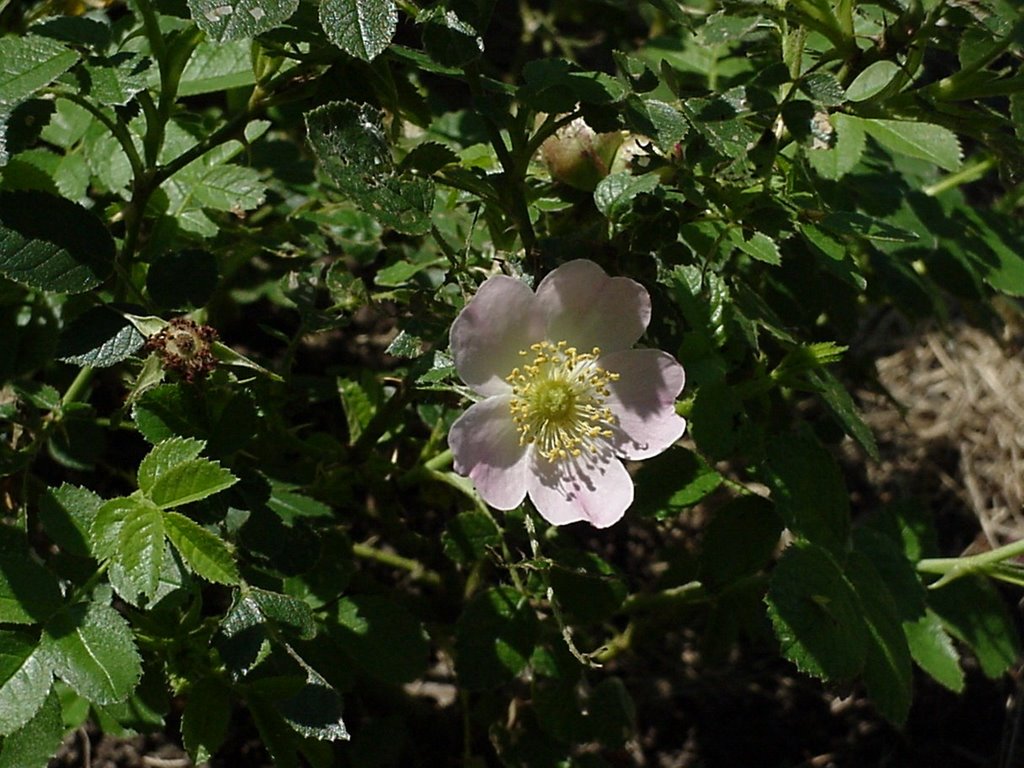
When the forsythia in my neighborhood begins to bloom, it's time to spring prune the roses.
This photo is Rosa eglantine, a rose that Shakespeare spoke of in A Midsummer Night's Dream. The rose is not fabulous to see, but walk past it at the right time of day and the 'green apple' fragrance is stunning. I should add the apple fragrance is from the leaves of the r. englantine.
"I know a bank whereon the wild thyme blows,
Where oxlips and the nodding violet grows
Quite over-canopied with luscious woodbine,
With sweet musk-roses, and with eglantine:
There sleeps Titania some time of the night,
Lull’d in these flowers with dances and delight
"A Midsummer-Night’s Dream" (2.1.260-5)
A little note of curiosity:
R. eglantine is the only rose in my yard that attracts gall making wasps.
Here is a photo of the R. eglantine hips. (Shrub is only about three years old.)

Subscribe to:
Posts (Atom)