"Pounding fragrant things -- particularly garlic, basil, parsley -- is a tremendous antidote to depression. But it applies also to juniper berries, coriander seeds and the grilled fruits of the chili pepper. Pounding these things produces an alteration in one's being -- from sighing with fatigue to inhaling with pleasure. The cheering effects of herbs and alliums cannot be too often reiterated. Virgil's appetite was probably improved equally by pounding garlic as by eating it.”
- Patience Gray

Showing posts with label altmed. Show all posts
Showing posts with label altmed. Show all posts
Tuesday, May 04, 2010


Sunday, March 28, 2010
quote
"There is hope for herbalism and natural healing in the 20th century. Everywhere a revival of interest and a new spirit of inquiry are evident... The debt to plants as the original sources of valuable modern medicines is today more readily acknowledged... The current revival of interest in the values, properties, and uses of nature's products gives hope that thousands of years of accumulated knowledge will not be completely buried in the stampede so dubiously named progress."
- John Lust, The Herb Book
- John Lust, The Herb Book
Monday, March 15, 2010
Rose Hip - Ginger Cordial
This ought to be a fun, tasty and efficacious herbal cordial.
In response to an opening question by Linda Conroy on "how do people use rose hips", the following recipe was posted on Facebook by Heather Nic An Fhleisdeir, who makes a low alcohol tincture of rosehips and fresh gingerroot. She wrote this on Feb. 26:
"(Fill) a jar one third the way full of dried deseeded rosehips, pouring just enough hot water over them to reconstitute and let cool. Fill with 40% alcohol (I like scotch whisky) and let steep three weeks. It has a nice body to it and since it is low in alcohol it extracts a nice amount of the nutrients. I like to mix it with my fresh ginger tincture, mmm"
Linda Conroy had posted: "Rose hips, fresh harvested from the wild contain between 1500-2500 grams of Vitamin C per 100 grams of weight. This is 47 times more than an orange. which contains around 53 mgs of Vitamin C per 100 grams of weight."
Of course it is easier to eat an orange... but rose hips are local, free, wildcrafted or cultivated food (uncontaminated with pesticides), and when you pick and process your own roses' hips, you become a personal part of the process of nourishing life.
I wrote: (I make) "Rose hip jam, but I always wonder if I'm destroying the Vit C by cooking? It does taste good, though."
Linda responded: "I do believe that some of the vitmain C is lost in each step of processing. The ultimate way to prepare roseship for optimal vitamin C is to prepare them fresh and not heating or drying them. This is why I like to steep them in honey or vinegar when they are fresh. But there are other nutrients that roseships offer when cooked, such as carotenes. (And since carotenes are fat soluable, roseship pie or cheese cake as mentioned above is ideal!)
Next year - rose hip honey, for sure!
Well, with all of that fresh knowledge, I decided to tincture some of my dried rose hips and in three week I'll add them to some ginger root honey I made.
Here is my method:
1/2 cup dehydrated rose hips
1/2 cup hot, not boiling water
Cover rose hips with water, allow to cool. Then add:
1/2 cup Jack Daniels (43 percent Alc. by vol.= 86 proof)
Cover and allow to tincture for 3 weeks in a cupboard, shaking the bottle every day.
At the end of 3 weeks,stir in ginger honey, made by infusing 1/2 cup honey and peeled sliced gingerroot.
 I'm not sure if I'll bother straining out the healthful solids to get a clear cordial - I'll try to keep this updated. However, rest assured, the rose hips and ginger won't go to waste.
In response to an opening question by Linda Conroy on "how do people use rose hips", the following recipe was posted on Facebook by Heather Nic An Fhleisdeir, who makes a low alcohol tincture of rosehips and fresh gingerroot. She wrote this on Feb. 26:
"(Fill) a jar one third the way full of dried deseeded rosehips, pouring just enough hot water over them to reconstitute and let cool. Fill with 40% alcohol (I like scotch whisky) and let steep three weeks. It has a nice body to it and since it is low in alcohol it extracts a nice amount of the nutrients. I like to mix it with my fresh ginger tincture, mmm"
Linda Conroy had posted: "Rose hips, fresh harvested from the wild contain between 1500-2500 grams of Vitamin C per 100 grams of weight. This is 47 times more than an orange. which contains around 53 mgs of Vitamin C per 100 grams of weight."
Of course it is easier to eat an orange... but rose hips are local, free, wildcrafted or cultivated food (uncontaminated with pesticides), and when you pick and process your own roses' hips, you become a personal part of the process of nourishing life.
I wrote: (I make) "Rose hip jam, but I always wonder if I'm destroying the Vit C by cooking? It does taste good, though."
Linda responded: "I do believe that some of the vitmain C is lost in each step of processing. The ultimate way to prepare roseship for optimal vitamin C is to prepare them fresh and not heating or drying them. This is why I like to steep them in honey or vinegar when they are fresh. But there are other nutrients that roseships offer when cooked, such as carotenes. (And since carotenes are fat soluable, roseship pie or cheese cake as mentioned above is ideal!)
Next year - rose hip honey, for sure!
Well, with all of that fresh knowledge, I decided to tincture some of my dried rose hips and in three week I'll add them to some ginger root honey I made.
Here is my method:
My Version Rose hip and Ginger root Cordial
March 11, 2010
1/2 cup dehydrated rose hips
1/2 cup hot, not boiling water
Cover rose hips with water, allow to cool. Then add:
1/2 cup Jack Daniels (43 percent Alc. by vol.= 86 proof)
Cover and allow to tincture for 3 weeks in a cupboard, shaking the bottle every day.
At the end of 3 weeks,stir in ginger honey, made by infusing 1/2 cup honey and peeled sliced gingerroot.

Saturday, December 26, 2009
My version of Elderberry Cough Syrup
It's really pretty tasty! And I think it's working during this germ-y season... I'll let you know.
I made some elderberry tincture last winter after taking a class by Jim McDonald that turned me on to tincturing, and then finding dehydrated berries for sale at a reliable beer-making supply shop.
Oh! BTW, a little news: Herb just learned this week that he won a third Silver Medal in the 2009 Great Lakes International Cider & Perry Competition, for his locally sourced, homemade (non-commercial) spiced apple wine. It really is good!
Back. Anyway, my tincture seemed nice, but I never really had a need to use it. I seem to be awfully healthy for such a broken down old gal (knocking on wood).
The only elderberries I've been able to find 'growing wild' are so near to roads that I don't trust their safety. This spring I planted a couple of tiny shrubs from the Conservation District in my backyard, but of course they need some time to grow.
Elderberry has been talked about by so many herbalists, especially during the recent season of flu scare, that I thought I'd try my hand at making and using 'it'. Most of the cough syrup recipes I've seen seem similar enough, so I thought I'd do my own riff and let you know how it turned out.
What I did
In a large saucepan combine:
1/2 cup dried elderberries
2 cups hot water
Bring to a boil while stirring constantly, then lower the heat and simmer about an hour, mashing berries occasionally.
(If you used fresh berries, you would only need a little water to keep from burning the berries initially, and you could simmer just long enough to juice the berries, but that's another recipe.)
Keep the lid on while simmering, and don't boil. If you can smell the berries in clouds of steam, then valuable essential nutrients are escaping into the air.
Remember, mash occasionally.
Pour it all into a cheesecloth lined 4-cup measuring cup to strain. Let sit to drain thoroughly.
Squeeze gently and discard berry pulp. (I set it aside to feed to my worm bin.)
Measure liquid and pour back in saucepan. To 1 1/2 cups juice stir in one generous cup of honey, heating briefly to blend well.
Remove from heat. For enhanced keeping quality, stir in 4 oz.* vodka, brandy or tincture.
Here is my innovation: I added that Elderberry tincture that I had made last fall. Double the berry, double the fun!
*By volume 8 + 12= 20 oz. : 20%= 4 oz.
I bottled mine in a quart canning jar with a plastic lid. It's pretty nice syrup - it's be good over ice cream or cake, or for an aperitif or a nightcap.
But to use 'medicinally' in the folk tradition, an adult dose would be a teaspoon a day. But look at the ingredients - a Tablespoon wouldn't hurt either, or stirring a teaspoon into a cuppa tea more often than once a day wouldn't hurt, might help build your resistance to cold and flu.
I made some elderberry tincture last winter after taking a class by Jim McDonald that turned me on to tincturing, and then finding dehydrated berries for sale at a reliable beer-making supply shop.
Oh! BTW, a little news: Herb just learned this week that he won a third Silver Medal in the 2009 Great Lakes International Cider & Perry Competition, for his locally sourced, homemade (non-commercial) spiced apple wine. It really is good!
Back. Anyway, my tincture seemed nice, but I never really had a need to use it. I seem to be awfully healthy for such a broken down old gal (knocking on wood).
The only elderberries I've been able to find 'growing wild' are so near to roads that I don't trust their safety. This spring I planted a couple of tiny shrubs from the Conservation District in my backyard, but of course they need some time to grow.
Elderberry has been talked about by so many herbalists, especially during the recent season of flu scare, that I thought I'd try my hand at making and using 'it'. Most of the cough syrup recipes I've seen seem similar enough, so I thought I'd do my own riff and let you know how it turned out.
What I did
In a large saucepan combine:
1/2 cup dried elderberries
2 cups hot water
Bring to a boil while stirring constantly, then lower the heat and simmer about an hour, mashing berries occasionally.
(If you used fresh berries, you would only need a little water to keep from burning the berries initially, and you could simmer just long enough to juice the berries, but that's another recipe.)
Keep the lid on while simmering, and don't boil. If you can smell the berries in clouds of steam, then valuable essential nutrients are escaping into the air.
Remember, mash occasionally.
Pour it all into a cheesecloth lined 4-cup measuring cup to strain. Let sit to drain thoroughly.
Squeeze gently and discard berry pulp. (I set it aside to feed to my worm bin.)
Measure liquid and pour back in saucepan. To 1 1/2 cups juice stir in one generous cup of honey, heating briefly to blend well.
Remove from heat. For enhanced keeping quality, stir in 4 oz.* vodka, brandy or tincture.
Here is my innovation: I added that Elderberry tincture that I had made last fall. Double the berry, double the fun!
*By volume 8 + 12= 20 oz. : 20%= 4 oz.
I bottled mine in a quart canning jar with a plastic lid. It's pretty nice syrup - it's be good over ice cream or cake, or for an aperitif or a nightcap.
But to use 'medicinally' in the folk tradition, an adult dose would be a teaspoon a day. But look at the ingredients - a Tablespoon wouldn't hurt either, or stirring a teaspoon into a cuppa tea more often than once a day wouldn't hurt, might help build your resistance to cold and flu.
Friday, January 26, 2007
herbies in the digital age
While looking for some information for our (GCHS) herb study about Echinacea, I ran across these podcasts by HerbEd, A.K.A. Ed Smith, a very interesting and knowlegeable herbalist.
So... yesterday, on The Backyard Herbalist weblog I posted some links (click here) to interesting programs that you can listen to on your computer or download to listen to on an Ipod-type mp3 player. I subscribed to the podcasts (easy, free) and they download automatically.
You can even burn them on a cd and play it in your car, if you don't Ipod.
You don't have to watch soap operas.
So... yesterday, on The Backyard Herbalist weblog I posted some links (click here) to interesting programs that you can listen to on your computer or download to listen to on an Ipod-type mp3 player. I subscribed to the podcasts (easy, free) and they download automatically.
You can even burn them on a cd and play it in your car, if you don't Ipod.
You don't have to watch soap operas.
Wednesday, June 07, 2006
A Short History of Medicine
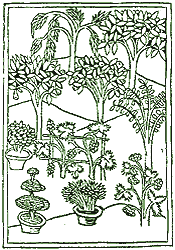
2000 BC - Here, eat this root.
1000 AD - That root is heathen. Here, say this prayer.
1850 AD - That prayer is superstition. Here, drink this potion.
1940 AD - That potion is snake oil. Here, swallow this pill.
1985 AD - That pill is ineffective. Here, take this antibiotic.
2000 AD - That antibiotic doesn't work anymore. Here, eat this root!
Subscribe to:
Posts (Atom)