January is dreamtime for gardeners and I finally have time, after an
over-stressed over-scheduled December, to sit down with all of the
mail-order garden catalogues I piled in a basket next to my favorite
chair since Thanksgiving. Last week I dedicated an afternoon to
checking out the catalogues.
There are pros and cons to using catalogues.
Con: You pay for shipping. But Pro: You usually don't pay sales tax.
Con: You don't get to make an 'on the spot' evaluation of the health
of the plant as you would in a nursery. But Pro: You usually get a
better deal with catalogues, a wider choice of unusual varieties, and
good mail order nurseries want repeat business so they stand behind
their plants, in case one arrives with problems.
There are plants I'll plan to buy at local stores, just because I
know that I can get a better deal and a common variety and a sturdy
plant, but still, I'm drawn to catalogues. They are part of the
gardening tradition for good reason.
For one thing, the best catalogues are great learning resources. They
describe plants. The best ones use plantsman's language, even
botanical names. If you read the better catalogues you will begin
saying and thinking botanical names. The good catalogues will tell
you tell you how to grow individual plants, what spacing and light
and watering and other factors they require.
And the luscious color photographs spark my creative thinking. I've
planted more imaginary gardens in January than I ever will have time
or space or money enough to plant in May.
Favorites? Plenty.
However...I order from:
Bluestone. My all time favorite catalogue to see in the mailbox. Small but healthy perennial at prices that don't make choosing too difficult. Somethimes has a jump on the competition in offering new plants. Fun coupons. Discounts. Recycling deal on packaging that helps with shipping. Nice people.
Nichols. Herb and flower seeds. Hops.
Park seed. Garden porn photos, always a killer "gotta have" plant .
Burpee. Veggie seeds.
======================
A relevant quote from a popular Michigan garden guru, Janet Makunovich:
"Make your catalogues support your plans rather than drive them.
Define your plans first, by re-organizing and re-reading notes, and then go to catalogues with a purpose."
Monday, January 22, 2007


Sunday, January 21, 2007
CSI: In My Garden
The January Herb Study at the GCHS was Echinacea.
To paraphrase an old television drama "There are a million stories in the" ...garden... "here is one of them..."
A few years ago I began to notice some significant problem with my purple coneflowers. What! Nothing bothers purple coneflowers! Right!?!
BUT, if something is gonna happen in way of a garden disaster large or small, it'll happen to me.
On closer inspection of my blighted flowers, all of the the ruined cones seemed to be damaged in the same way... blackened broken centers. I cut off the worst flowers and brought them indoors and dissected them on my kitchen counter. Eyuck, small wormy creatures had burrowed straight down from the tip of the seedhead right down into the stem. I took some photos with my first generation digital camera and went out to the garden and deadheaded all of my Echinacea. Dejectedly. I love purple coneflowers.
I couldn't find any clue in my books, or the books at the Extension, or
online, or by asking around. Closest I could figure was a hint from several online sources that certain flowers attract the European Corn Borer, the timing was right, and the damage was identical. It fit the profile of a native plant being decimated by an imported pest, especially because the pest was probably under pressure from all of the cornfields that have surrounded my neighborhood being bulldozed for new subdivisions. But I was still unsettled about it. The little larvae I had didn't look right, I was seeing stripes and the ECB is spotted. I knew from my time working with the Diagnostic team that the distinction was important. All burrowing larvae are not the same.
I even asked flower experts at conferences. Apparently I didn't paint a grim enough portrait of the damage these flowers were suffering. No one knew or cared. Years passed. I deadheaded as needed, dejectedly.
January 2007, the Genesee County Herb Society's herb study will be Echinacea. It's January, time to read with a purpose! Looking through my coneflower photos from years past, the CSI photos sparked my interest in finding the name of that little grub.
I Googled around and came across a paragraph in a paper I downloaded from the Connecticut Agricultural Experiment Station, entitled Perennial Medicinal Herb Trials 1996-1999. On page 7, under Echinacea purpurea L. Moench. is this sentence:
"Echinacea is a member of the aster family, and susceptible to the same insects. Sunflower moth larvae damaged more than 80% of blooms cut in late summer."
Googling furiously, I brought up: "Sunflower Moth" page 3 on a publication from the Maryland Cooperative Extension with a GREAT PHOTO!
Success!
Identification of a pest is the first step in IPM. I feel much better.
Now I have to figure out how to save my purple coneflowers from this particular larvae.
NOTE: Cross-posted to The Backyard Herbalist
To paraphrase an old television drama "There are a million stories in the" ...garden... "here is one of them..."
A few years ago I began to notice some significant problem with my purple coneflowers. What! Nothing bothers purple coneflowers! Right!?!
BUT, if something is gonna happen in way of a garden disaster large or small, it'll happen to me.
On closer inspection of my blighted flowers, all of the the ruined cones seemed to be damaged in the same way... blackened broken centers. I cut off the worst flowers and brought them indoors and dissected them on my kitchen counter. Eyuck, small wormy creatures had burrowed straight down from the tip of the seedhead right down into the stem. I took some photos with my first generation digital camera and went out to the garden and deadheaded all of my Echinacea. Dejectedly. I love purple coneflowers.

I couldn't find any clue in my books, or the books at the Extension, or
online, or by asking around. Closest I could figure was a hint from several online sources that certain flowers attract the European Corn Borer, the timing was right, and the damage was identical. It fit the profile of a native plant being decimated by an imported pest, especially because the pest was probably under pressure from all of the cornfields that have surrounded my neighborhood being bulldozed for new subdivisions. But I was still unsettled about it. The little larvae I had didn't look right, I was seeing stripes and the ECB is spotted. I knew from my time working with the Diagnostic team that the distinction was important. All burrowing larvae are not the same.
I even asked flower experts at conferences. Apparently I didn't paint a grim enough portrait of the damage these flowers were suffering. No one knew or cared. Years passed. I deadheaded as needed, dejectedly.
January 2007, the Genesee County Herb Society's herb study will be Echinacea. It's January, time to read with a purpose! Looking through my coneflower photos from years past, the CSI photos sparked my interest in finding the name of that little grub.
I Googled around and came across a paragraph in a paper I downloaded from the Connecticut Agricultural Experiment Station, entitled Perennial Medicinal Herb Trials 1996-1999. On page 7, under Echinacea purpurea L. Moench. is this sentence:
"Echinacea is a member of the aster family, and susceptible to the same insects. Sunflower moth larvae damaged more than 80% of blooms cut in late summer."
Googling furiously, I brought up: "Sunflower Moth" page 3 on a publication from the Maryland Cooperative Extension with a GREAT PHOTO!
Success!
Identification of a pest is the first step in IPM. I feel much better.
Now I have to figure out how to save my purple coneflowers from this particular larvae.
NOTE: Cross-posted to The Backyard Herbalist
Friday, January 19, 2007
Wednesday, January 17, 2007
"To create a garden is to search for a better world. . . . Whether the result is a horticultural masterpiece or only a modest vegetable patch, it is based on the expectation of a glorious future. This hope for the future is at the heart of all gardening."
-- Marina Schinz (Swiss garden writer and photographer)
-- Marina Schinz (Swiss garden writer and photographer)
Monday, December 18, 2006
housekeeping
I've been remiss in updating the garden blog, so much is going on in my life and the political blog, the poetry blog, the entertainment blog, and the quote for the day blogs are all time consuming enough.
Anyway, this morning I linked to a great resource for "how to talk to global climate change skeptics", and thought to myself, this is off topic, and I reallly need to get back to my garden blogging roots.
Time for a New Year's Resolution... My garden blog will soon be reverted to gardening and my ecological concerns will be posted on my new garden politics blog..."migreenroof". The link can be found over there on the right where it says "view my complete profile." Click on that link and the list of some related blogs (no not all of the above), including the new Michigan Green Roof blog, will appear.
Herbies might be interested in The Backyard Herbalist blog. It's a public portal for a Yahoo Group for the MSU Extension Herb Garden project. You don't have to be a Master Gardener or a Herb Society member to volunteer there, it is a demonstration herb garden for the community. Just contact me and we'll talk about it.
Tuesday, December 12, 2006
For GCHS members...
I started and will moderate a (GCHS members only) Yahoo Group for the Genesee County Herb Society. You are invited to join if you have paid your 2007 GCHS dues to Ulrike. Welcome!
(FYI: You'll need an account with Yahoo, but it's EASY, and FREE to sign up. You just make up a "screen name" and a private password)

Click here to join gcherbs
(FYI: You'll need an account with Yahoo, but it's EASY, and FREE to sign up. You just make up a "screen name" and a private password)
Click here to join gcherbs
Sunday, December 03, 2006
Planting a Sequoia
by Dana Gioia
All afternoon my brothers and I have worked in the orchard,
Digging this hole, laying you into it, carefully packing the soil.
Rain blackened the horizon, but cold winds kept it over the Pacific,
And the sky above us stayed the dull gray
Of an old year coming to an end.
In Sicily a father plants a tree to celebrate his first son’s birth--
An olive or a fig tree--a sign that the earth has one more life to bear.
I would have done the same, proudly laying new stock into my father’s orchard,
A green sapling rising among the twisted apple boughs,
A promise of new fruit in other autumns.
But today we kneel in the cold planting you, our native giant,
Defying the practical custom of our fathers,
Wrapping in your roots a lock of hair, a piece of an infant’s birth cord,
All that remains above earth of a first-born son,
A few stray atoms brought back to the elements.
We will give you what we can — our labor and our soil,
Water drawn from the earth when the skies fail,
Nights scented with the ocean fog, days softened by the circuit of bees.
We plant you in the corner of the grove, bathed in western light,
A slender shoot against the sunset.
And when our family is no more, all of his unborn brothers dead,
Every niece and nephew scattered, the house torn down,
His mother’s beauty ashes in the air,
I want you to stand among strangers, all young and emphemeral to you,
Silently keeping the secret of your birth.
Thursday, November 30, 2006
sharing
I was looking through some old files and ran across this photo a gardening friend sent me of a waterfront rock garden she noticed somewhere or other in Michigan.


Wednesday, November 29, 2006
a model
I can't remember where I copied this photo. If you have a legit objection, I'll remove it, but I'm sharing it to inspire people. Share joy, reinforce life! The photographer's name is in the corner. It is the herb garden at UC-Davis.


Monday, October 30, 2006
a peaceful scene
Simplicity, lighting. The genius of the place, a backyard. It says Peace to me.
Another unknown source.

Another unknown source.

Monday, October 16, 2006

Tuesday, October 03, 2006
busy busy busy - more about rose hips
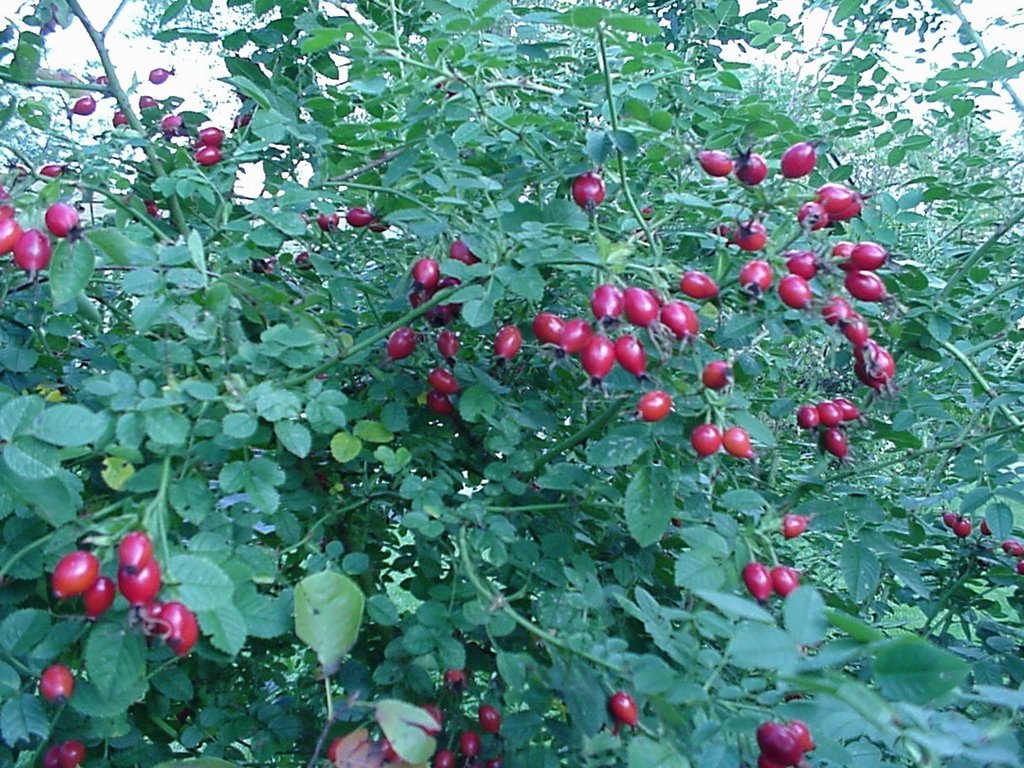
Out gathering more rose hips, these from the R. englatine (the one whose foliage smells like fresh green apples)and cleaning and drying them in the dehydrator for tea.
I clean them by cutting off the ends and scooping out the middle- seeds, furzy stuff, and once in a while a leetle white worm. Then pop the hips in the dehydrator.
Good for you.
Did I tell you my German-American friend, Ulrike's story about growing up poor in wartime Germany. The kids would pick rosehips on the way to school to eat, and scrape the furzy stuff in the middle out to use as "itching powder" to tease the other kids... Kids will be kids. I seem to remember reading that during the same war English kids were fed rosehips as well, both sides' children were sorely lacking good sources of Vitamin C, such as citrus fruit, and rose hips being the very best source of C and its accompanying bioflavinoids.
Check the C bottles next time you go past the Vitamin counter at the store, they still add rose hips to better brands.

Friday, September 29, 2006
Autumn Song
Autumn Song by Margurite Kingman
The firelight glows,
The embers sigh,
We dream and
Doze--
The cat and I.
The kitten purrs,
The kettle sings,
The heart remembers
Little things.
The 'little thing' in the photo is a clearwing or hummingbird moth, visiting the flowers of a butterfly bush. Thanks for sending me the photo, Bonnie.

The firelight glows,
The embers sigh,
We dream and
Doze--
The cat and I.
The kitten purrs,
The kettle sings,
The heart remembers
Little things.
The 'little thing' in the photo is a clearwing or hummingbird moth, visiting the flowers of a butterfly bush. Thanks for sending me the photo, Bonnie.
Monday, September 18, 2006
containers
I'll share a secret, I Google images of people's vacations. Hey! I'll never afford traveling to the places I'd like to see... so I live vicariously. But that's better than some bad habits I could have.
This is a balcony in Rome.
If you post it for everyone to see, you might find it on someone's blog, Bubbie.

This is a balcony in Rome.
If you post it for everyone to see, you might find it on someone's blog, Bubbie.

Thursday, September 14, 2006
The Herb Gatherer
By Glenn Ward Dresbach
From Collected Poems, 1914-1948
When fragrant fires of autumn smoulder
By upland pastures for wind to blow
And grain shocks stand, row after row,
He throws a sack across his shoulder
And trudges away in the mellow glow
To gather herbs – though he is older
Than most of the old men I know.
He squints in the sun, and always follows
The spring brook where the calamus hides
And he nibbles it, and away he strides
For thyme and tansy in sunny hollows,
Then on to burdock. His faith abides
in it for bitters, in careful swallows,
When winter had chilled his old insides.
Sage and boneset – his eyes keep sighting
Out of profusion the things he would find.
Pennyroyal, horse mint – these he will bind
In neat little bundles, always righting
Some slight disorder . . . at least in his mind.
He will hang them on rafters, ready for fighting
The ills of age . . . with the years so kind!
His old cheeks flush with the autumn weather.
His old eyes shine when the quail wings sound.
A sack that smells of the air and the ground
With tang and mellowness there together
Over his shoulder! And all around
The breath of autumn! . . . I wonder whether
Gathering helps more than the herbs he found.
Wednesday, September 13, 2006
so gather your rosebuds, too, girls
TO THE VIRGINS, TO MAKE MUCH OF TIME
by Robert Herrick
GATHER ye rosebuds while ye may,
Old time is still a-flying:
And this same flower that smiles to-day
To-morrow will be dying.
The glorious lamp of heaven, the sun,
The higher he's a-getting,
The sooner will his race be run,
And nearer he's to setting.
That age is best which is the first,
When youth and blood are warmer;
But being spent, the worse, and worst
Times still succeed the former.
Then be not coy, but use your time,
And while ye may go marry:
For having lost but once your prime
You may for ever tarry.
This poem played a role in Dead Poets Society when Robin Williams used it to inspire his students, thus...
"They're not that different from you, are they? Same haircuts. Full of hormones, just like you. Invincible, just like you feel. The world is their oyster.
They believe they're destined for great things, just like many of you, their eyes are full of hope, just like you.
Did they wait until it was too late to make from their lives even one iota of what they were capable?
Because, you see gentlemen, these boys are now fertilizing daffodils.
But if you listen real close, you can hear them whisper their legacy to you.
Go on, lean in. Listen, you hear it?
Carpe ... hear it?
Carpe ... carpe diem, seize the day boys, make your lives extraordinary. "
Tuesday, September 12, 2006
gather your roseHIPS while ye may... and make jam
 I know, it's rosebuds in the poem, and the common wisdom says gather rosehips after the first frost. (It supposedly kills any harboring insects.) But I like to pick them in the beginning of autumn, but before the frost hits, when they are ripened but still firm, like an apple. If you wait for the weather to turn you'll lose alot of them to drying up, mushiness, those little 'worms' will grow and ruin the fruit, and so on.
So I say, pick them NOW, and make jam...
Here's my Rosehip Jam recipe.
Pick some rosehips. I pick about a colander full. So you know right now, this recipe is not precise, but it works. Some say the big apple-y R. rugosa type are the best. They are big and pretty, and look like little apples... see the photo.
But this year I liked the hips from my R. glauca because it is so prolific and the hips are nice and clean of insects. Because I grow without chemicals, the R. rugosa has some little worms in many of the hips this year. Hey, I never promised you a rose garden. But the photo is pretty, isn't it.
Next, wash the hips, cut them all in half, then go through and clean out the seeds and little odd bits. Soak the cleaned hips in water (enough to cover) in the pot you will cook them in, for several hours, which will soften them.
Then when you are ready to make jam, bring the pot to a boil, and boil for 15 minutes, uncovered.
Strain the boiled water/juice into a large measuring cup. In this case I got 1 1/2 cups. Set the fruit aside, and add an equal measure of sugar (in this case, 1 1/2 cups sugar) to the liquid, and stir to dissolve it.
Boil the sugared water/juice until it thickens, stirring constantly.
Add the fruit and cook, stirring, until it is a nice jammy consistency.
Be careful not to burn it.
Your rosehip jam will be beautiful, it looks a bit like cherry jam.
Pour into clean jars and cap. Label, Store in the fridge.
In this case I got three jelly jars, filled. Here's a picture:

Sunday, September 10, 2006
Saturday, September 09, 2006
Friday, September 01, 2006


Subscribe to:
Posts (Atom)