In the garden:
Commercial culinary ginger is Zingiber officinalis.
Requires little care. Keep moderately moist. 50% + humidity.
Ginger should receive full sun-to part shade. Humus-rich soil. ph 6.5 well drained soil.
Divide rhizomes in early spring; plant horizontally 1 inch deep.
Harvest: Rhizomes in late autumn, cutting off leafstalks and removing fibrous roots. Keep a rhizome to start the next year's plants.
I planted one in summer, 2000 from Meijer's produce department. It grew!
The stems and leaves were so thin they were surprising to me.
The leaves developed yellow spots but it didn't seem to hinder the plant. the stress of mind and hail shredded the leaves as well. Seems to need more protection from extreme weather.
In February, the stems and leaves turned yellow, one by one, and started to drop off (in the same way that voodoo lily scapes do, at the base). By Feb 25th the whole plant was dormant.
2001: The replanted rhizome did well, the leaves were healthier and not spotted at all this year. It produced a nice replacement rhizome as well as it's own smaller one. Behaved the same, but I guess it yellowed in mid-winter, maybe December. I left it out to dry and pretty well forgot it until March.
2002: Spring: still looks viable. Planted the best part in a 8" plastic pot, kept it outside in summer and indoors in winter. This one looks healthier than last year- the leaf fronds are thicker and taller. Started dying back again in January, and I quit watering, though I left it in the S window. Gradually died off, I unpotted it Jan. 30, 2003 and took a few pictures of the roots- healthy, the tubers are much rounder and shinier than the store-bought tubers. I am keeping one half, broken away as I unpotted it, to use, and one will be repotted right away.
The repotted root took a long time to resprout, with the cool spring, it may have been waiting for warmth?
Sept. 2003: The gingerroot in the refrigerator rotted/molded. I didn't use it!!!
The replanted root looks just great, best yet. No spots, no yellowing, no shredded leaves. But the root BURST its pot! Needs to be repotted.
I repotted it into a much larger clay pot, but cut half of the storage root off to use.
Time to start another ginger. Bought a big one in April in Meijers' produce department, and put it under the light, bare. May 2006: Cut it in three - one to use now, and two to plant in the big flat bowl-shaped pot. The nubby tips are turning green and the outermost tips are very green and starting to sprout.
(See ginger folder in 'Recipes' file...)
Buy fresh gingerroot at Meijers- costs about $2/lb. A very large root is about 1/2 lb, or 2 cups prepared fresh pieces. December 2000: I used the second recipe for candied gingerroot, the third looks good too.
The Best Use: peel and slice into vodka, store in refrigerator. Slices are useful indefinitely, the vodka picks up the ginger flavor.
OR- Candied Ginger
CANDIED GINGER
1 c Ginger Root -peeled and thinly sliced
1 c Water
1/2 c Maple Syrup
In a small saucepan stir together the ginger,water and maple syrup. Place over medium heat and simmer untill liquid is completely evaporated about 25 to 30 minutes. Watch carefully during the last 10 minutes of cooking to prevent syrup from burning. Seperate pieces and place on a lightely greased cooking cooling rack .Dry in a 200 degree oven untill all syrup is absorbed and pieces snap when broken,about 2 hours.
From Rodale Stocking up III cookbook.
Candied Ginger
HERB COMPANION, Oct/Nov 1997
1/2 pound fresh ginger
water to cover
1 1/2 cups sugar
1 1/2 cups water
2 tablespoons light corn syrup
Crystallizing ginger is a lengthy process, but having these choice sweets on hand is reward enough.
1. Peel 1/2 pound fresh ginger and slice 1/4 inch thick. Bring to a boil in water to cover. Simmer, covered for 2+1/2 hours. Drain, simmer in fresh water for another hour, or until tender. Drain.
2. Bring to a boil 1+1/2 cups sugar, 1+1/2 cups water, and 2 tablespoons light corn syrup; cook for 2 minutes. Add the ginger. Remove from the heat and let stand until cool, or overnight.
3. Again bring the syrup to a boil. Simmer, stirring occasionally, for 1 to 3 hours, or until the ginger is translucent. If the syrup thickens too quickly, thin with a little hot water.
4. Remove the pan from the heat and set the ginger pieces on a wire rack to dry for a few hours. Roll them in granulated sugar and store in a glass jar.
(May get moldy.)
Third recipe: Instructions:
Day 1: Scrape and cut into 1/4 inch slices enough non-fibrous young Ginger root to make 1 quart. Put the slices into a large non-aluminum pat and cover generously with water. Bring slowly to the boil, simmer, covered until tender (20 min). Add 1 cup sugar and stir until the mixture boils.
Remove from heat. Cover and let stand overnight at room temperature.
Day 2: Recook, simmering gently for about 15 min (after coming to the boil). Add 1 seeded sliced lemon and 1 cup light corn syrup. Uncover and simmer 15 minutes longer, stirring occasionally.
Remove from heat and let stand covered overnight.
Day 3: Bring the mixture to the boil again and add 1 cup sugar and simmer for 30 min STIRRING CONSTANTLY (burns easily). Add 1 cup sugar, bring back to the boil and remove from heat.
Cover and let stand overnight again.
Day 4: In the fourth cooking, bring the mixture to a boil once more. When the syrup drops heavily from the side of a spoon, and the ginger is translucent, pour the mixture into sterile jars and seal. This yields about 5 cups.
If you want Candied ginger...drain the ginger after the last cooking. Reserve the syrup for flavoring sauces and allow the slices to dry on a sheet or better still a rack, overnight. When well dried, roll in granulated sugar and store in tightly covered glass jars.
You can then boil the reserved liquid until it is reduced to a syrup with a consistency somewhere between maple syrup and honey. This will intensify its flavor. This syrup can be used for pancakes, waffles, or ice cream, and is an extra bonus for making your own candied ginger.
Ginger Compress
1/2 c Fresh Ginger Rhizome
2 c Water
[From Herbal Medicine for Dummies]
1. Grate the Ginger into a small saucepan.
2. Add the water and simmer for 15 minutes.
3. Let steep for 15 minutes.
4. Soak a washcloth in the strong tea and apply to painful or stiff muscles until the compress cools. Do this 3 to 4 times and then repeat the process 2 to 3 times a day.
Vary it: For inflamed muscles and strong pain, try alternating the ginger compress with a cold or even icy compress with 1 minute of the cold to 4 minutes of the hot.
Notes: Try this ginger compress for back strains, sprains, bruises, and other injuries. You gain the most benefit with this herbal treatment by using it several times a day for a few days.
Ginger Info
(Zingiber officinale) The feeling of nausea is a symptom
that can accompany a wide range of organic or metabolic
disorders and emotional trauma. Ginger is used for all
types of nausea, including morning sickness and motion
sickness. It has a warming effect and is supportive to the
digestion while stimulating circulation.
Ginger has a protective effect on the stomach and liver
as well, and is the best spice to use for people with liver
and digestive problems. It is taken as a powder in capsules
for alleviating nausea (2 capsules 3 times daily), as a tea
by simmering dried or fresh ginger slices, or as a tincture
(2 droppersful 2 to 3 times daily).
==================================
GINGER (herb of the Moon) -- used to make sure
your spells are effective. Ginger is eaten before spells
to make them successful, or simply added to herbal
mixtures, also used for love spells.
=========================
From: Herbs for the Home, McVicar
This is good for indigestion, flatulence, nausea, and
poor circulation. Chewing a piece of any ginger is an
effective deterrent to travel sickness. Ginger tea
is good for flus and colds.
========================
LLewllyn's 1999 Magical Almanac
Ginger, know in ancient China and India, tones,
uplifts and warms the system, stimulates digestion
and circulation, calms upset stomach, and relieves
nausea, aches and pains. Ginger can be eaten in
candied slices, honey-based syrups, encapsulated
or drunk as a tea.
===============================
Ginger Tea helps appetite loss, motion sickness,
up-set stomach, relieves gas, loosens phlegm, and
soothes earaches. To 1 teaspoon of ginger add 1 cup
boiling water. Steep 5 minutes. (By Diane Kennedy
Snyder of Diane's Herbal Shop )
============================
Ginger: masculine, Mars, Fire. Magical attributes:
Power, success, love. History/Uses: Back to Egypt
in the time of Cheops, people were making gingerbread;
4400 years ago, the Chinese were importing this
herb for the same reason, and to act as an aid to
indigestion or colds (tea form).
Carry the root of ginger in your purse to ensure
prosperity, or make it into a fine drink for summer
days.
Wednesday, May 24, 2006


Tuesday, May 23, 2006
humor day
Hmmmm.
Remember the joke about the guy in prison telling his wife where the stolen goods were buried? I wonder if that's why the FBI is digging up that Milford farm looking for Jimmy Hoffa?
Since we're off to on a humor tangent, today a gardener's joke:

Remember the joke about the guy in prison telling his wife where the stolen goods were buried? I wonder if that's why the FBI is digging up that Milford farm looking for Jimmy Hoffa?
Since we're off to on a humor tangent, today a gardener's joke:

Monday, May 22, 2006
spring has sprung
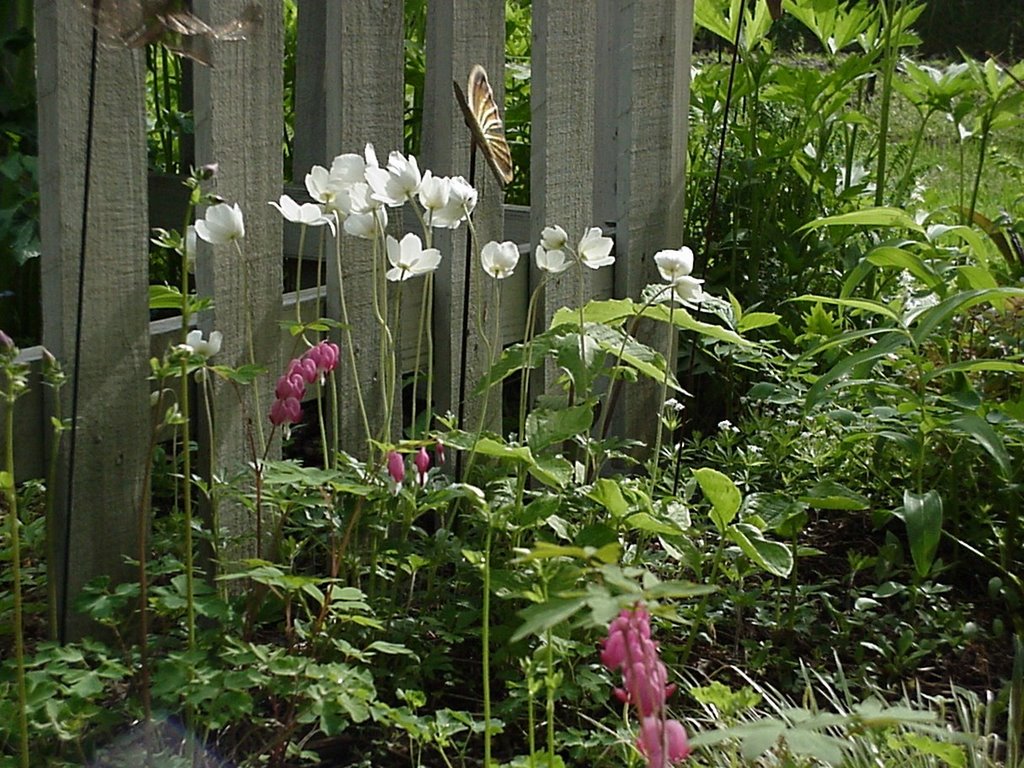 Anemones and Bleeding Hearts along the shady path, can you see the volunteer Jack in the Pulpit?
Sunday, May 21, 2006
The Family's Traditional Potato Salad
All the measurements are approximate. Herb's sister came over to our apartment after we were married in 1971, and she made their mother's potato salad to show me how it was done, and I took notes.
The recipe has changed only to account for our changing tastes during the years...
Potato Salad
Makes a big bowlful
5-6 large potatoes: prick with a fork and boil in the skins until done through, then cool enough to peel and chop into a large mixing bowl with:
1/2 cup onion, chopped
1 cup celery, chopped
3 large dill pickles, chopped
1/2 jar roasted pimento, drained, patted dry and chopped
5 hard-boiled eggs, chopped
(optional: chopped radish, chopped red or green pepper)
Sauce:1 cup Hellman's Mayonnaise, low fat is acceptable but not preferable
1-2 T French's yellow mustard
a pinch of Coleman's dry mustard, adjust to taste
1-3 T cider vinegar
1 t. salt, adjust to taste
LOTS of fresh ground pepper
finely chopped parsley
Mix all the ingredients, and garnish. I top it with sliced hard-boiled eggs and a sprinkle of paprika, and parsley sprigs. I like it best when I first make it, but for convenience, cover tightly and chill until serving time.
The recipe has changed only to account for our changing tastes during the years...
Potato Salad
Makes a big bowlful
5-6 large potatoes: prick with a fork and boil in the skins until done through, then cool enough to peel and chop into a large mixing bowl with:
1/2 cup onion, chopped
1 cup celery, chopped
3 large dill pickles, chopped
1/2 jar roasted pimento, drained, patted dry and chopped
5 hard-boiled eggs, chopped
(optional: chopped radish, chopped red or green pepper)
Sauce:1 cup Hellman's Mayonnaise, low fat is acceptable but not preferable
1-2 T French's yellow mustard
a pinch of Coleman's dry mustard, adjust to taste
1-3 T cider vinegar
1 t. salt, adjust to taste
LOTS of fresh ground pepper
finely chopped parsley
Mix all the ingredients, and garnish. I top it with sliced hard-boiled eggs and a sprinkle of paprika, and parsley sprigs. I like it best when I first make it, but for convenience, cover tightly and chill until serving time.
Saturday, May 20, 2006
a hen and her chicks

Grown on rooftops in Germanic and Scandinavian countries to avert lightning, ostensibly because it was sacred to the god Thor, Sempervivums are now being used as "green roof" plants.
Mine are planted in corners and niches where I want a little lagniappe of interest. This photo shows them in a chicken shaped wire egg basket with a broken crockery chicken stuck in the top where the mother plant died last year after blooming and sending out her chicks.
This link is to is another website concerning these easy favorites and other succulents. Here is a "copy and paste" snippet:
CRASSULACEAE IN ANCIENT ROME:
Crassulaceae were indeed cultivated in antiquity, but only a few. This family usually grows in regions with consistent higher temperatures and no frost in winter. Nevertheless there are some genera which are native in the area of ancient rome and greece.
THE reference for plants in ancient rome is 'Naturalis Historiae' by Pliny the Elder (C. Plinii Secundi).
In his books he describes hundreds of plants in use during his time, mostly medicinal and agricultural plants. The crassulaceae described by Pliny had mostly medicinal uses, but also mythological.
The Sempervivum was planted on roofs of houses to protect the house against lightning. The plants of this genus were considered sacred to Jupiter in Roman and to Thor in Teutonic mythology.
Jupiter and Thor were associated with thunderbolts - it is said their beard can be seen in the flowers, hence the Romans also called it 'Jupiter's Beard' (Jovis Barbam). It was also cultivated in pots and beds in roman gardens.
This habit is not as far fetched as one might think - todays science has an explanation:
Due the acute (pointed) leaves, the equalisation of the electrical charge between the house and the air is eased, therefore the chance of a spark discharge is lowered. Sure this effect might be tiny, but in case of a lightning bolt it can be essential if it discharges or not.
Sempervivums are known as rosette-leaf succulents. It's latin name splits up into Semper - always and vivum - living. We commonly know the Sempervivum as houseleek, 'Hen and Chicks' or Jupiter's Beard.
All plants of this genus are more or less cold-hardy. They are native to central and southern Europe, the islands of the Mediterranean and northern Africa. Furthermore they grow in regions at sea-level, but also in alpine regions.
The myth of the protective feature for house was adopted in medieval times and was documented in Charlemagne's (Karl der Große) "capitulare de villis":
§70: [...] Et ille hortulanus habeat super domum suam Iovis barbam. [...]
"And there the gardener ought to have the 'Iovis barbam' over his own house."
Sempervivum as medicine:
The roman-greek scholar Dioscorides (Dioskurides) (~40-~90AD) mentioned the sempervivum in his work 'De materia medica' and recommended crushed leaves with wine to get rid of intestinal parasites. Mashed leaved were also used to treat burns and scalds. Cut leaves were used against warts, calluses, corns and insect stings - the juice was used to treat shingles and earache.
'Naturalis Historiae' by Pliny the Elder is by far the best reference for uses of the Sempervivum. In countless passages he mentions the Sempervivum against articular gout, diarrhea, worms, stomach pain and more. The usage was either internal (juice), rubbing on the area of pain or simply applying parts of the plant on the body.
Pliny uses several names for one species, but comparisons with other ancient authors lead to a certainty for attributing to modern species names.
Sempervivum
Pliny sci-name common name
aeizoon Sempervivum aizoon (Bolle) Christ. Hauswurz; houseleek
aizoum Sempervivum tectorum L.
sedum Sempervivum L. Eigentliche Hauswurz; houseleek
Other common names: Houseleek, Jupiter's Eye, Jupiter's Beard, Thor's Beard, Bullock's Eye, Sengreen, Ayron, Ayegreen, Donnersbart
[preliminary version]
© 2003 Captain
last modified: 11-JUN-2003
Friday, May 19, 2006
Johnny Jump Ups
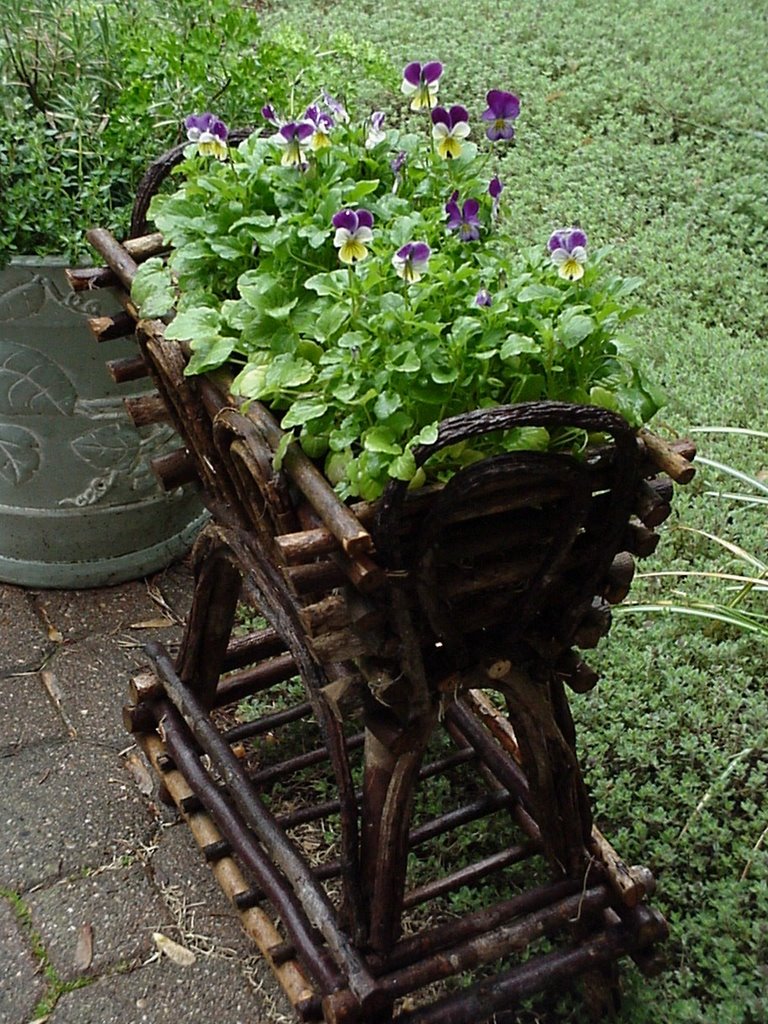
Doesn't matter which way you plant them, they always seem to end up looking at you in the morning!

Wednesday, May 17, 2006
Recipe: Flavored Honey

Aromatic Honey
Source: Herbs For Health Sept/Oct, 1999
1 drop culinary essential oil (1-2 drops)
1/4 cup honey
Pour the honey into a glass jar and add 1 drop of essential oil. Stir well.
Add a second drop if desired. Cover and store away from heat and light.
These honeys will keep forever, but some may crystallize. To reliquify,
loosen the lid and place the jar in hot water until the honey melts. Never
heat these honeys in the microwave.
NOTE : This recipe is a delightful way to introduce even the staunchest skeptic to culinary essential oils. Some good oils to use are ginger, cardamon, rose, peppermint or bergamot. You can also use the oils individually or in combination. Try combining peppermint and ginger, rosemary and lemon or cinnamon and orange.
These honeys are delicious added to coffee or tea, and are effective digestive aids taken after a meal. Or use them to make an instant tea when traveling; just add 1 teaspoon to a cup of hot water and enjoy.
Tuesday, May 16, 2006
keeping bees

This article from a British newspaper caught my eye. I've thought about beekeeping for years now.
Why London's beekeepers are a growing band
Laura Barnett finds out what beekeepers get out of it - and why shops are clamouring for their honey
Published: 04 May 2006
http://news.independent.co.uk/
The first summer that Nicky Faith kept bees in her back garden, she built a pyramid 15 jars wide with the honey they made. Now, 10 years on, her three beehives take pride of place in her garden, and the labels on her jars of Willesden Green Honey picture a bucolic scene far from this crowded corner of north-west London.
Nicky, a part-time adult literacy teacher in her fifties, is one of a growing number of Londoners keeping bees. According to Government estimates, at least 2,000 people keep bees within the M25 - double the number recorded in 1999. For many city-dwellers, having beehives offers a way to get closer to nature and ensures a supply of pure, locally produced honey. Keeping bees is less a hobby than a green way of life.
"I've always been green, I suppose," Nicky says, sitting at her scrubbed kitchen table in prime position to observe her bees at work around the magnolia tree. "I care about having locally produced food. And I've always loved country life - this is the closest I can get to keeping livestock."
John Chapple, beekeeper for 25 years and chairman of the London Beekeepers' Association for 10, also believes that keeping bees is an ideal way for people with limited space to feel more in touch with nature.
"What other kind of animal can you keep in two square feet of space?" he points out. John once had 40 beehives on allotments and at his home in Acton, west London. He now keeps bees in Regent's Park.
But London beehives are not confined to parks and gardens. Robin Pemberton-Jones, a former governor of the Bank of England, kept hives on top of the Bank, and LBA beekeepers provide honey for the Archbishop of Canterbury from hives in Lambeth Palace's gardens. Other LBA members keep bees at the Natural History Museum and on top of Fortnum and Mason.
"People from all walks of life keep bees in cities," says John. "I've seen hundreds of new members join recently. When I started, they were all old men; now they're mainly ladies, and a lot of younger people too. They're health-conscious and more environmentally aware."
Surprisingly, smoggy urban streets are said to provide a purer honey than rolling fields. City gardens, parks and allotments offer a wider variety of flowers than is found now in the countryside, and pollution seems to have no effect on honeybees. According to a survey conducted last year by French beekeepers' association, Unaf, city-dwelling bees are healthier and more productive than their country cousins, avoiding the ill effects of pesticides used by farmers and filtering out urban pollution.
"The countryside seems green and clean, but the crops are often covered in pesticides," explains James Hammill, a former actor turned owner of The Hive Honey Shop in south London, which stocks honey produced at the Hammills' 40 hives across London and southern England. "Bees in cities produce more honey. We get 40 to 50 jars per hive every season in our country apiaries; in the city, we get more like 150 jars."
Not only do urban bees enjoy the range of flowers on offer, they can help keep cities green. Bees are crucial to pollination, so keeping bee colonies, even on a small scale, can help plants to flourish. "The more we keep bees, the more flowers and trees there will be," Nicky Faith comments. "It's a green activity."
Amateur and small-scale commercial beekeepers also avoid the blending and processing methods employed by many of the major supermarket chains, producing a more natural honey.
Nicky shudders at the mere thought of mass-produced supermarket brands. "When people say they don't like honey it's because they've only tried the ones you get in the supermarket," she says. Robert Carpenter-Turner, one-time opera singer, portrait photographer and president of the North London Beekeepers' Association, agrees. Membership of the NLBKA has grown to more than 120. He believes this is mainly due to people's increasing concerns about where their food comes from.
"There's a greater desire to eat organic, locally produced food," he says. "Supermarkets usually blend different types of honey to get a certain colour. There's nothing like eating your own honey, and London honey is absolutely premium stuff."
There is a growing demand for good honey. In January, Waitrose reported that sales of honey overtook those of marmalade for the first time. Demand for London honey outstrips supply; Robert and Nicky are approached by health-food shops and delicatessens, and can seldom meet demand.
It's not just the taste of urban honey that's sought after - many claim that it offers health benefits. As bees feed on the pollen in a particular area, those suffering the effects of the high urban pollen count can find eating local honey alleviates symptoms.
"People come to me for honey because they have hay fever," Robert explains. "If it's local, it seems to have a sort of immunising effect."
Other London beekeepers are used to this request. James Hammill started stocking honey-based hay-fever remedies when friends began to swear by them, and John Chapple has hay-fever sufferers coming back year after year asking for his west London honey.
But keeping bees is not just a matter of buying a hive and waiting for the honey to flow. City-based beekeepers face concerned neighbours and the threat of vandalism, and need considerable training to manage hives of up to 60,000 bees.
At introductory courses run by the London Beekeepers' Association, Robert's north London-based group, and the Hive Honey Shop, prospective urban beekeepers can get a feel for beekeeping, meeting experts ready to impart advice.
It is standing room only at the final session of a 10-week LBA course held at Roots and Shoots, an environmental charity just south of the Thames. Mostly under 50, the students are evenly split between men and women. They include 16-year-old Simon, attending the course with his mother, and Elizabeth Dix, a 27-year-old broadcast assistant for Radio Three.
"I grew up in the Jersey countryside and always fancied having animals," says Elizabeth. "Bees are perfect to keep in London - it's like having pets, but you don't have to spend all your time with them."
For stressed-out city-dwellers, the time they do spend with their bees can prove therapeutic. Investment manager Julian Lim, also on the course, says his degree in philosophy drew him to bees. "I'm fascinated by the primitive social language of bees," he says.
The magic of keeping bees so compelled James Hammill that he decided to continue the beekeeping tradition started by his father and grandfather in California.
"Watching bees is a form of meditation," he says. "It really is therapeutic; it relieves stress."
Nicky Faith agrees. "But the greatest moment is opening the hive and seeing the honeycomb," she says. "That's a kind of miracle. That makes it all worthwhile."
Bee prepared
Books about beekeeping can provide a good introduction, but there's no substitute for practical experience. Contact your local beekeeping association to find out about courses for beginners.
n London Beekeepers' Association www.lbka.org.uk
n British Beekeepers' Association www.bbka.org.uk
Think carefully about where to put your apiary. Hives should be sheltered from wind, preferably south-facing for warmth, and close to a source of water.
Talk to your neighbours before installing hives. People can be taken aback by the sight of thousands of bees suddenly feasting in their garden.
Try hiding your apiary behind a trellis or wall. This reduces the risk of vandalism and will help avoid confrontations with neighbours. And look for good-tempered bees. Like all creatures, some types of bee are more docile than others. Local bee inspectors and experienced beekeepers can advise on which strains are least likely to sting.
Monday, May 15, 2006
a garden song

Thought the first track, "After the Garden is Gone", of the new, much discussed Neil Young album is great in a gardenish sort of way. After all, aren't good gardeners supposed to care about the earth? I'd copying the lyrics but you can stream the whole album free, from the website.
Sunday, May 14, 2006
If it were not for the cracked pots
An elderly Chinese woman had two large pots, each hung on the ends of a pole which she carried across her neck. One of the pots had a crack in it that caused it to leak, while the other pot was perfect and always delivered a full portion of water.
At the end of the long walk from the stream to the house, the cracked pot arrived only half full. For a full two years this went on daily, with the woman bringing home only one and a half pots of water.
Of course, the perfect pot was proud of its accomplishments. But the poor cracked pot was ashamed of its own imperfection, and miserable that it could only do half of what it had been made to do.
After 2 years of what it perceived to be bitter failure, it spoke to the woman one day by the stream. "I am ashamed of myself, because this crack in my side causes water to leak out all the way back to your house."
The old woman smiled, "Did you notice that there are flowers on your side of the path, but not on the other pot's side? That's because I have always known about your flaw, so I planted flower seeds on your side of the path, and every day while we walk back, you water them."
"For two years I have been able to pick these beautiful flowers to decorate the table. Without you being just the way you are, there would not be this beauty to grace the house."
Each of us has our own unique flaw. But it's the cracks and flaws we each have that make our lives together so very interesting and rewarding. You've just got to take each person for what they are and look for the good in them.
To all of my crackpot friends, have a great day and remember to smell the flowers. And remember...........all of us aren't perfect.
At the end of the long walk from the stream to the house, the cracked pot arrived only half full. For a full two years this went on daily, with the woman bringing home only one and a half pots of water.
Of course, the perfect pot was proud of its accomplishments. But the poor cracked pot was ashamed of its own imperfection, and miserable that it could only do half of what it had been made to do.
After 2 years of what it perceived to be bitter failure, it spoke to the woman one day by the stream. "I am ashamed of myself, because this crack in my side causes water to leak out all the way back to your house."
The old woman smiled, "Did you notice that there are flowers on your side of the path, but not on the other pot's side? That's because I have always known about your flaw, so I planted flower seeds on your side of the path, and every day while we walk back, you water them."
"For two years I have been able to pick these beautiful flowers to decorate the table. Without you being just the way you are, there would not be this beauty to grace the house."
Each of us has our own unique flaw. But it's the cracks and flaws we each have that make our lives together so very interesting and rewarding. You've just got to take each person for what they are and look for the good in them.
To all of my crackpot friends, have a great day and remember to smell the flowers. And remember...........all of us aren't perfect.
Saturday, May 13, 2006

Friday, May 12, 2006
mom always said thank you notes were important

I received a nice thank you note today from another blogger whose work I re-posted,
Bob Higgins, of Worldwide Sawdust.
In the column "Dick Cheney Helped Me Till My Garden" he wrote essentially about today's poisoned political climate and what it is doing to so-called average citizens in our personal lives.
He wrote about the process of writing (he is a writer, visit his site, there is a fine piece up right now about time and perspective), about the relatively new art of blogging with its self-imposed demands and discipline, and about the relief of being able to set aside the digital matrix world that connects us to hourly world-wide outrages, by the simple act of opening the back door, taking in a deep cleansing breath, and stepping outside.
The real world act of being in the "now" that nature gives to any of us who makes time for it is pure pleasure to the senses. There is the physical exertion of gardening with sun and breeze on skin and muscles working, the savour and fragrance of eating real food, the connectedness in hearing the birds, in seeing color not manufactured by a lit screen.
My own computer is right next to a southeast window looking out at a blooming dogwood tree as I type. Through my shut window I can hear the robins telling each other where the worms are, and I'm asking myself, what am I doing in here? Ah, well today is rainy and cold.
I know Bob is talking metaphor, that is a sign of good writing. I think back to the old philosophical bones I used to gnaw. Quality. Time. Ethics. Nature. Some of us will never escape the lure of the ancient Greeks. Maybe this political climate is what made me begin my study of "mazes and labyrinths", which I promise to talk more about as time permits. I know at other times in my life, the poets and the classics did more for my well being than just about anything else. The timelessness of their questions and attempts at answers make me part of the pattern of a long and caring segment of humanity.
Well, to close for today, I must admit I had some decision to make about the Dick Cheney piece, whether to post it on my "all sweetness and light" garden blog, or on my "this blog kills fascists" political blog. The garden blog won out because of the garden respite theme, and anyone reading my garden blog will either have to put up with an occasional political piece or just quit reading.
This is just a blog, my blog. You can make your own if you choose to, or, better yet, leave a comment.
Thursday, May 11, 2006
chocolate and vanilla
A little design fun today - a garden of chocolate and vanilla.
I've thought of chocolate gardens before, we did that on the AOL garden bulletin boards back in the nineties. But I add a tad of vanilla to enhance the chocolate flavor, just like in cooking.
Color, variety name, or fragrance puts a plant on this plant list.
Accessories can include: cocoa cans as containers and coco hull mulch
Vanilla (coumarin):
sweet woodruff
heliotrope
vanilla grass
valerian
knifofia 'vanilla'
Joe Pye weed
clematis montana rubra
Chocolate:
(thinking of browns and apricot shades, with bronze foliage)
Chocolate cosmos, Cosmos atrosanguineum
Chocolate flower, Berlandiera lyrata
Chocolate mint
Chocolate-mint scented geranium
Chocolate daisy, Berlandiera lyrata
Ajuga 'Chocolate Chip'
heuchera 'Chocolate Ruffles' and heuchera 'Chocolate Veil'
eupatorium 'Chocolate'
Carex buchananii
bronze fennel
daylilies, irises, cosmos
Angelica gigas
nasturtium 'Mahogany', or apricot shades
Aquilegia 'Chocolate Soldier'
edge with alyssum 'Apricot Tapestry'
pepper 'Chocolate Soldier'(Seymour's Select Seeds)
anise basil
painted lady beans in Nichols catalogue: "mocha colored pods and beans"
morning glory, Ipomoea imperialis 'Chocolate' (T&M)
Wilson's anemone clematis: C. montana montana var. wilsonii
Calycanthus floridus (sweet shrub)
I've thought of chocolate gardens before, we did that on the AOL garden bulletin boards back in the nineties. But I add a tad of vanilla to enhance the chocolate flavor, just like in cooking.
Color, variety name, or fragrance puts a plant on this plant list.
Accessories can include: cocoa cans as containers and coco hull mulch
Vanilla (coumarin):
sweet woodruff
heliotrope
vanilla grass
valerian
knifofia 'vanilla'
Joe Pye weed
clematis montana rubra
Chocolate:
(thinking of browns and apricot shades, with bronze foliage)
Chocolate cosmos, Cosmos atrosanguineum
Chocolate flower, Berlandiera lyrata
Chocolate mint
Chocolate-mint scented geranium
Chocolate daisy, Berlandiera lyrata
Ajuga 'Chocolate Chip'
heuchera 'Chocolate Ruffles' and heuchera 'Chocolate Veil'
eupatorium 'Chocolate'
Carex buchananii
bronze fennel
daylilies, irises, cosmos
Angelica gigas
nasturtium 'Mahogany', or apricot shades
Aquilegia 'Chocolate Soldier'
edge with alyssum 'Apricot Tapestry'
pepper 'Chocolate Soldier'(Seymour's Select Seeds)
anise basil
painted lady beans in Nichols catalogue: "mocha colored pods and beans"
morning glory, Ipomoea imperialis 'Chocolate' (T&M)
Wilson's anemone clematis: C. montana montana var. wilsonii
Calycanthus floridus (sweet shrub)
Wednesday, May 10, 2006
gardening

MEMORIAL GARDEN
by Pam Crow
You worship in the dirt,
on your knees with a trowel
in your hand. You push
seeds into the earth, slowly,
the way hard truths push
into our hearts, take root there,
pressing the walls larger
to let more light in.
You tell me you don't know
any God, but what of this
conversation of flowers?
Bee Balm, Love in the Mist whisper
to lavender and pansies
yearly we return.
Here, too, is what we wish
we could control: aphids black
on the slender necks of roses,
silver gleams where slugs pass
munching the sweetest stems
right down to the ground.
When so many are gone
I think this is the place to be--
dividing, planting,
making room.
Copyright © Pam Crow
Tuesday, May 09, 2006
garden therapy

I read this excellent post yesterday, and knew EXACTLY what the writer is saying. You may not agree with our politics, but you can probably recall a time when you just had to leave it all behind and get a little garden therapy, too.
As Joni Mitchell sang "...and we've got to get ourselves back to the garden..."
Dick Cheney Helped Me Till My Garden
by Bob Higgins
on Sat 06 May 2006
I had intended to write a piece on Cheney’s speech in Vilnius yesterday and wrestled with the idea all afternoon and through the evening, at last too tired, too disinterested in the bastard to finish reading his painfully pompous and threatening remarks much less write about it I gave up.
Finally, I posted the whole sorry thing on my blog under the title "Cheney Lets Mouth Overload Ass, Full Text" and went to bed. To sleep, perchance to wake inspired.
No Dice. This morning over coffee and in the early light of a new day, Cheney’s snoratory was just as ugly and uninspired, just as threatening and bullyish and just as arrogant as it had been the night before. The smug son of a bitch spoke for a half hour, over four thousand words and left nothing to edify, to stir the better natures of his listeners, he delivered only empty platitudes and chest thumping, self serving bombast.
I still couldn't do it, the morning was beautiful and promised only to improve with time and personal attention so I decided that I would not share this lovely day with a bloodless cyborg so I finished my coffee and went out to till my garden.
The garden was an instant cure, balm for a frustrated soul, as the tiller growled and turned the loamy soil I felt myself unwind. At the end of each pass as I turned the machine around there were robins in my earthy wake happily plundering the bounty the tiller had exposed. The breeze freshened each time the clouds eclipsed the morning sun and subsided with each clearing, stilling for a moment the music of the leaves.
I worked through the morning and into the early afternoon hoeing and raking, enjoying the aroma of the rich soil and it’s promise of fat tomatoes and fiery peppers. I’ve been cautioned to take it easy so I paced myself and rested from time to time, something I would not have done a few short months ago. I discovered that I’m not able to be manic about physical labor anymore, I’ve grown old over this long winter. Life has found me out, has discovered my secret youth and carried it off forever.
In these unaccustomed breaks I heard the hundreds, no perhaps a thousand birds who shared my morning and saw and felt them cushioned on the breeze as if held aloft on a palm of wind and I felt the sun, it’s warmth, on my arms and on my neck a comfort of spring and peace, the peace of sounds and scents and sights of earth, and spring, and God himself.
I stopped for lunch and made a sandwich, a great noble sandwich. Out of sight of any physician I piled on the salami, the cheese and the peppers, the hearty basil and fragrant oil. I scorned the mortician as I ate this tour de force, this Kervorkian delight of a sandwich, I devoured it while sitting on the deck watching the birds enjoy my morning’s labor.
How good to work without madness, with calmness an enjoyment of the thing itself, I have to learn to do this as I write, I have to learn to feel the breeze.
Cheney will wait an hour, a day, or more, and a thousand dragon windmills will wait to feel the sting of my lance. I’ll meet them on the field, as a loyal legionnaire, I’ll answer the trumpets in my soul with the same determination as always, but today Dick Cheney’s awful speech in Vilnius has helped me till my garden.
Bob Higgins
Monday, May 08, 2006
Recipe: Chimichurri
Chimichurri
The bright flavors of fresh parsley and garlic make this vibrant sauce sauce a favorite accompaniment to beef. It packs a punch, so start with just a drizzle.
(From the Epicurious website)
3 tablespoons red-wine vinegar
2 tablespoons water
1 tablespoon minced garlic (4 cloves)
1/2 bay leaf, broken in half
3/4 teaspoon salt
1/2 teaspoon dried hot red pepper flakes
1/2 teaspoon coarsely ground black pepper
1/4 cup olive oil
1/2 cup finely chopped fresh flat-leaf parsley
Stir together vinegar, water, garlic, bay leaf salt, red pepper flakes, and black pepper until salt is dissolved.
Whisk in oil until combined, then whisk in parsley. Let stand for 30 mintues at room temperature. Discard bay leaf and stir sauce before serving.
Cooks' note:
Chimichurri can be made up to 1 hour ahead and kept, covered, at room temperature.
Makes about 3/4 cup.
Gourmet
January 2005
The bright flavors of fresh parsley and garlic make this vibrant sauce sauce a favorite accompaniment to beef. It packs a punch, so start with just a drizzle.
(From the Epicurious website)
3 tablespoons red-wine vinegar
2 tablespoons water
1 tablespoon minced garlic (4 cloves)
1/2 bay leaf, broken in half
3/4 teaspoon salt
1/2 teaspoon dried hot red pepper flakes
1/2 teaspoon coarsely ground black pepper
1/4 cup olive oil
1/2 cup finely chopped fresh flat-leaf parsley
Stir together vinegar, water, garlic, bay leaf salt, red pepper flakes, and black pepper until salt is dissolved.
Whisk in oil until combined, then whisk in parsley. Let stand for 30 mintues at room temperature. Discard bay leaf and stir sauce before serving.
Cooks' note:
Chimichurri can be made up to 1 hour ahead and kept, covered, at room temperature.
Makes about 3/4 cup.
Gourmet
January 2005
Friday, May 05, 2006
Cultivating generosity, wisdom over the years
Something in this old "gardening" article spoke to me:
Cultivating generosity, wisdom over the years
By Charles Fenyvesi
Washington Post
April 2001
WASHINGTON -- In 19 years of filing a weekly garden column, I celebrated two kinds of gardeners. An exemplar of the first kind was Frank Santamour Jr. of the U.S. National Arboretum, author of numerous scholarly studies on trees, who died last year.
He concluded that the longevity of trees is related to their ability to compartmentalize wounds.
The second kind was an adventurous gardener, such as the late Charles Thomson, a pillar of the Men's Garden Club of Montgomery County (Md.), who credited the extraordinary vigor of his daffodils and tulips to his practice of putting the bulbs an inch deeper than called for by the instructions.
People devoted to cultivating plants tend to be naturally gregarious. Sharing their know-how and presenting their arguments, they invite visitors into their private domains beyond the palisades of conventional wisdom.
Santamour's theory about wound compartmentalization holds that once the damage is done, the tree reacts so the problem (which also could be an infection or an onslaught by pests) is isolated, spreads no farther and the plant returns to its usual enterprise of growth.
Although a strict rationalist, he did not object to the metaphor that at least some trees have a kind of central authority that evolved a system to cope with problems. He would not call it wisdom, and he would have hated to be taken for a druid.
Look at the empirical side, Santamour would emphasize: The mechanism for proper compartmentalization is in a narrow collar around a limb or a branch as it grows out of the trunk or another limb or branch. Therefore, we must not saw off a limb or a branch flush, but leave something like a clerical collar around the growth we remove.
Thomson's thinking also fitted into a larger vision of plant life. But he distrusted science as "only partial truth or truth-in-becoming." To him, the garden was not just a testing ground but reality itself. He was a whimsical gardener who loved the biblical story of a seemingly dead almond staff rooting itself in the soil and bursting into bud and bloom.
I think he accepted me as a friend when I cited an even wilder analogy: Moses turning his staff into a snake, and then making a point with the Pharaoh by having that snake devour the other snakes that the Pharaoh's magicians conjured up the same way.
Almost everything in the garden depends on the gardener, Thomson used to say, but first the soil must be made ready: deep dug and enriched constantly. His daffodil and tulip bulbs and their numerous offsets cradled in the deep earth would have choked for lack of oxygen or drowned when waterlogged if he had not added manure and compost to a depth of 2feet. The stalks seemed to rise out of his bulbs as effortlessly as if the medium had been soft, uniform sand rather than upgraded clay.
He much preferred to unlock what he believed were the treasures of clay, and he did not like the idea of adding to what he called the bottomless pit of nutrient-poor sand.
The garden is the space where the tangible and the metaphoric shift back and forth, and the demands of soil and soul, humdrum routine and magical exception run parallel and then intersect, again and again.
One secret I learned is to dig deeper and keep devising ways to improve the soil, the part of the world that is in our hands. And when the time comes for transplanting, we must make the new site even more hospitable than the old.
This was Charles Fenyvesi's final column for The Washington Post.
Cultivating generosity, wisdom over the years
By Charles Fenyvesi
Washington Post
April 2001
WASHINGTON -- In 19 years of filing a weekly garden column, I celebrated two kinds of gardeners. An exemplar of the first kind was Frank Santamour Jr. of the U.S. National Arboretum, author of numerous scholarly studies on trees, who died last year.
He concluded that the longevity of trees is related to their ability to compartmentalize wounds.
The second kind was an adventurous gardener, such as the late Charles Thomson, a pillar of the Men's Garden Club of Montgomery County (Md.), who credited the extraordinary vigor of his daffodils and tulips to his practice of putting the bulbs an inch deeper than called for by the instructions.
People devoted to cultivating plants tend to be naturally gregarious. Sharing their know-how and presenting their arguments, they invite visitors into their private domains beyond the palisades of conventional wisdom.
Santamour's theory about wound compartmentalization holds that once the damage is done, the tree reacts so the problem (which also could be an infection or an onslaught by pests) is isolated, spreads no farther and the plant returns to its usual enterprise of growth.
Although a strict rationalist, he did not object to the metaphor that at least some trees have a kind of central authority that evolved a system to cope with problems. He would not call it wisdom, and he would have hated to be taken for a druid.
Look at the empirical side, Santamour would emphasize: The mechanism for proper compartmentalization is in a narrow collar around a limb or a branch as it grows out of the trunk or another limb or branch. Therefore, we must not saw off a limb or a branch flush, but leave something like a clerical collar around the growth we remove.
Thomson's thinking also fitted into a larger vision of plant life. But he distrusted science as "only partial truth or truth-in-becoming." To him, the garden was not just a testing ground but reality itself. He was a whimsical gardener who loved the biblical story of a seemingly dead almond staff rooting itself in the soil and bursting into bud and bloom.
I think he accepted me as a friend when I cited an even wilder analogy: Moses turning his staff into a snake, and then making a point with the Pharaoh by having that snake devour the other snakes that the Pharaoh's magicians conjured up the same way.
Almost everything in the garden depends on the gardener, Thomson used to say, but first the soil must be made ready: deep dug and enriched constantly. His daffodil and tulip bulbs and their numerous offsets cradled in the deep earth would have choked for lack of oxygen or drowned when waterlogged if he had not added manure and compost to a depth of 2feet. The stalks seemed to rise out of his bulbs as effortlessly as if the medium had been soft, uniform sand rather than upgraded clay.
He much preferred to unlock what he believed were the treasures of clay, and he did not like the idea of adding to what he called the bottomless pit of nutrient-poor sand.
The garden is the space where the tangible and the metaphoric shift back and forth, and the demands of soil and soul, humdrum routine and magical exception run parallel and then intersect, again and again.
One secret I learned is to dig deeper and keep devising ways to improve the soil, the part of the world that is in our hands. And when the time comes for transplanting, we must make the new site even more hospitable than the old.
This was Charles Fenyvesi's final column for The Washington Post.
Thursday, May 04, 2006
Organic Gardening Tips
Brother Placid's Tips for Beginning Organic Gardeners
by Emily Gatch
From Seeds of Change
I finally have what I consider a suitable response to the good people who call us at the Research Farm and say, "I want to garden organically. Where do I start?" My response comes in a format that I hope will prove memorable to you: a glimpse into the life and garden of a masterly Master Gardener, Brother Placid of New Melleray Abbey.
I'd like you to take a look with me at an organic vegetable garden on the edge of the prairie in eastern Iowa.
Brother Placid operates the twelve acre organic garden at New Melleray, a Trappist monastery and certified organic beef cattle farm near Dubuque, Iowa that was founded 150 years ago by monks from Mount Melleray, Ireland. Brother Placid's garden feeds not only his community of Cistercian monks of the Strict Observance but the year-round visitors to the monastery's guesthouse as well. His credentials and history as a gardener command rapt attention. He is one of fifteen children born to a Polish farming family in northern Minnesota. He had a reputation among his brothers and sisters as his mother's favorite, a status he attributes to his willingness to spend long hours helping her weed in the vegetable garden. At the age of eleven, during the height of the Great Depression, Brother Placid left home to work on the threshing crews that followed the grain harvest north along the Red River valley. He hopped freight trains out West and worked in the orchards of Washington state as an "apple knocker", dug potatoes in the Oregon's Klamath Valley, picked peaches and harvested vegetable crops in the Willamette Valley, and then moved down into California's central valley working the rice, cotton, and olive harvests. After serving in the army during World War II, he joined the monks at New Melleray and has been there ever since.
A brief look at Brother Placid's garden. He divides the twelve acres into three sections, rotated in the following manner:
One third of the garden is planted each year in alfalfa, which he mows three times over the summer and then turns under in the fall. The following spring, that section is planted in sweet corn, a nutrient-hungry crop that benefits from the 125 pounds of nitrogen fixed by the alfalfa. The remaining third is devoted to innumerable varieties of tomatoes, melons, squash, cucumbers, spinach, beets, turnips, potatoes, and his beloved grapes and berries.
Here are a few of Brother Placid's tips for beginning organic gardeners:
Feed the soil, not the plants. This is the dogmatic theology of organic agriculture. If you are just starting out with a barren plot of ground, devote one year to growing nothing but green manures: quick-growing clovers, oats, and annual grasses that are successively tilled into the soil. By planting and tilling under four different green manure crops and adding old chicken manure and rotting alfalfa bales, Brother Placid was able to increase the organic matter content of a plot of land from less than 1% to 18%. Brother Placid also adds fish emulsion and kelp meal to the furrow before planting to create a nutrient-rich environment for developing seedlings.
Vigilance is the best form of pest control. Be in your garden every day, and be watchful. Brother Placid controls Colorado potato beetles on his potatoes by beginning to scout when the plants reach 12 to 14 inches high, and simply picking the bugs off and squashing them by hand.
Learn the secrets of companion planting. The mutually beneficial relationships among certain crops can result in reduced pest problems and increased yields. Brother Placid interplants radishes with his melons, since radishes are known to deter cucumber beetles. He also recommends cosmos flowers for attracting pollinators to the garden.
Welcome the snow, and use it to your advantage. Snow (as well as collected rainwater) contains small amounts of dissolved nitrates and is "soft," unlike well or city water, which often contains dissolved salts and minerals that leave unwanted residues on plant surfaces. Brother Placid opens his cold frames to allow the snow in, and even shovels it into his greenhouse in the winter!
Compost, both the noun and the verb. Brother Placid is lucky to have plentiful raw ingredients for his compost pile in the green refuse that comes from the monastery and guesthouse's vegetarian kitchen, to which he adds oak leaves, pine needles, and old hay and straw. He typically adds about twelve tons of compost to his garden each year. He warns vehemently against using walnut leaves or chips as a compost ingredient or soil amendment, noting that a previous gardener once added walnut chips to his soil and he is still observing, many years later, some localized detrimental effects of the allelopathic compounds present in walnut trees.
Balanced mulching.While surface mulching generally helps to reduce weed pressure and lower disease incidence in the vegetable garden, Brother Placid has found that straw or chip-based mulches invite mice and voles to take up residence in his garden, so he limits his use of mulch to the one acre asparagus patch and to his berries. Evaluate your varmint situation and adjust your use of mulch accordingly, or experiment with less rodent-friendly mulches such as biodegradable landscape fabrics.
Water wisely.Drip irrigation is a much-preferred method of supplying water to plants, since the moisture left on leaves from overhead sprinkling can lead to foliar diseases.
Remember that gardening is hard work, but good work. Brother Placid likes to think of the story of Adam and Eve, and what they were told when they were expelled from the Garden of Eden: "With suffering you shall get your food from the soil, every day of your life… it shall yield you brambles and thistles, and you shall eat wild plants. With sweat on your brow shall you eat your bread, until you return to the soil, as you were taken from it." He smiles as he thinks of this Genesis passage in the heat of the Iowa summer, knowing that he is doing God's work.
I hope you also find in these words not a message of gloom but a glorious invitation to get out in the garden and get moving. Thank you, Brother Placid, for sharing your infectious enthusiasm and wisdom with me on this Sunday morning in March, and blessings to all you gardeners as you begin a new season.
Emily Gatch
Greenhouse Coordinator and Assistant Seed Cleaner
by Emily Gatch
From Seeds of Change
I finally have what I consider a suitable response to the good people who call us at the Research Farm and say, "I want to garden organically. Where do I start?" My response comes in a format that I hope will prove memorable to you: a glimpse into the life and garden of a masterly Master Gardener, Brother Placid of New Melleray Abbey.
I'd like you to take a look with me at an organic vegetable garden on the edge of the prairie in eastern Iowa.
Brother Placid operates the twelve acre organic garden at New Melleray, a Trappist monastery and certified organic beef cattle farm near Dubuque, Iowa that was founded 150 years ago by monks from Mount Melleray, Ireland. Brother Placid's garden feeds not only his community of Cistercian monks of the Strict Observance but the year-round visitors to the monastery's guesthouse as well. His credentials and history as a gardener command rapt attention. He is one of fifteen children born to a Polish farming family in northern Minnesota. He had a reputation among his brothers and sisters as his mother's favorite, a status he attributes to his willingness to spend long hours helping her weed in the vegetable garden. At the age of eleven, during the height of the Great Depression, Brother Placid left home to work on the threshing crews that followed the grain harvest north along the Red River valley. He hopped freight trains out West and worked in the orchards of Washington state as an "apple knocker", dug potatoes in the Oregon's Klamath Valley, picked peaches and harvested vegetable crops in the Willamette Valley, and then moved down into California's central valley working the rice, cotton, and olive harvests. After serving in the army during World War II, he joined the monks at New Melleray and has been there ever since.
A brief look at Brother Placid's garden. He divides the twelve acres into three sections, rotated in the following manner:
One third of the garden is planted each year in alfalfa, which he mows three times over the summer and then turns under in the fall. The following spring, that section is planted in sweet corn, a nutrient-hungry crop that benefits from the 125 pounds of nitrogen fixed by the alfalfa. The remaining third is devoted to innumerable varieties of tomatoes, melons, squash, cucumbers, spinach, beets, turnips, potatoes, and his beloved grapes and berries.
Here are a few of Brother Placid's tips for beginning organic gardeners:
Feed the soil, not the plants. This is the dogmatic theology of organic agriculture. If you are just starting out with a barren plot of ground, devote one year to growing nothing but green manures: quick-growing clovers, oats, and annual grasses that are successively tilled into the soil. By planting and tilling under four different green manure crops and adding old chicken manure and rotting alfalfa bales, Brother Placid was able to increase the organic matter content of a plot of land from less than 1% to 18%. Brother Placid also adds fish emulsion and kelp meal to the furrow before planting to create a nutrient-rich environment for developing seedlings.
Vigilance is the best form of pest control. Be in your garden every day, and be watchful. Brother Placid controls Colorado potato beetles on his potatoes by beginning to scout when the plants reach 12 to 14 inches high, and simply picking the bugs off and squashing them by hand.
Learn the secrets of companion planting. The mutually beneficial relationships among certain crops can result in reduced pest problems and increased yields. Brother Placid interplants radishes with his melons, since radishes are known to deter cucumber beetles. He also recommends cosmos flowers for attracting pollinators to the garden.
Welcome the snow, and use it to your advantage. Snow (as well as collected rainwater) contains small amounts of dissolved nitrates and is "soft," unlike well or city water, which often contains dissolved salts and minerals that leave unwanted residues on plant surfaces. Brother Placid opens his cold frames to allow the snow in, and even shovels it into his greenhouse in the winter!
Compost, both the noun and the verb. Brother Placid is lucky to have plentiful raw ingredients for his compost pile in the green refuse that comes from the monastery and guesthouse's vegetarian kitchen, to which he adds oak leaves, pine needles, and old hay and straw. He typically adds about twelve tons of compost to his garden each year. He warns vehemently against using walnut leaves or chips as a compost ingredient or soil amendment, noting that a previous gardener once added walnut chips to his soil and he is still observing, many years later, some localized detrimental effects of the allelopathic compounds present in walnut trees.
Balanced mulching.While surface mulching generally helps to reduce weed pressure and lower disease incidence in the vegetable garden, Brother Placid has found that straw or chip-based mulches invite mice and voles to take up residence in his garden, so he limits his use of mulch to the one acre asparagus patch and to his berries. Evaluate your varmint situation and adjust your use of mulch accordingly, or experiment with less rodent-friendly mulches such as biodegradable landscape fabrics.
Water wisely.Drip irrigation is a much-preferred method of supplying water to plants, since the moisture left on leaves from overhead sprinkling can lead to foliar diseases.
Remember that gardening is hard work, but good work. Brother Placid likes to think of the story of Adam and Eve, and what they were told when they were expelled from the Garden of Eden: "With suffering you shall get your food from the soil, every day of your life… it shall yield you brambles and thistles, and you shall eat wild plants. With sweat on your brow shall you eat your bread, until you return to the soil, as you were taken from it." He smiles as he thinks of this Genesis passage in the heat of the Iowa summer, knowing that he is doing God's work.
I hope you also find in these words not a message of gloom but a glorious invitation to get out in the garden and get moving. Thank you, Brother Placid, for sharing your infectious enthusiasm and wisdom with me on this Sunday morning in March, and blessings to all you gardeners as you begin a new season.
Emily Gatch
Greenhouse Coordinator and Assistant Seed Cleaner
Wednesday, May 03, 2006

Tuesday, May 02, 2006
The Blogger Blues and Blueberry Lemon Brunch Cake
Couldn't post my daffodil pic yesterday, nor my cartoon today... and I can't spend time required to figure it out.
So I'll do something else today, but it has to be fast!
A recipe!
Lemon Blueberry Brunch Cake
Source: Pillsbury cake mix box
Posted in the GCHS newsletter Feb. '96
Servings: 16 (a 9"X13" pan)
Note: DEFinitely prepare the day ahead to allow flavors to develop.
Cake:
1 pkg. Pillsbury Plus lemon cake mix
1/4 c. margarine, softened
3 oz. cream cheese, softened
1/3 cup water
2 eggs
21-oz. can blueberry pie filling
1/2 cup slivered almonds
Note: Just after beating batter I fold in about one generous T. fresh lemon peel and about 1/4 cup fresh lemon herb leaves, chopped (l. verbena, l. thyme, or l. balm).
Note: If you make your own blueberry filling, as I do, make it thick, and use about 2-1/2 cups.
Glaze:
1/2 cup confectioners' sugar
2-3 t. milk
1 T. margarine, softened
Note: Recipe calls for 1/4 t. lemon extract in glaze, I omit.
Directions:
Preheat oven to 350 degrees.
In mixer bowl, cut together cake mix, margarine, and cream cheese to form fine crumbs. Reserve 1 cup. Combine almonds with reserved crumbs and set aside.
To remaining crumbs add water and eggs, beating 2 minutes at high speed with mixer. (Fold in lemon peel and herbs.)
Spread in greased, floured pan. Spoon pie filling over batter, spreading to cover batter to edges. Sprinkle reserved crumbs over filling.
Bake at 350 degrees for 35-45 minutes *until edges are browned and toothpick tests clean in center*. Cool 25 minutes.
Drizzle glaze over warmish cake, cover, and store in refrigerator. Will taste best the next day.
So I'll do something else today, but it has to be fast!
A recipe!
Lemon Blueberry Brunch Cake
Source: Pillsbury cake mix box
Posted in the GCHS newsletter Feb. '96
Servings: 16 (a 9"X13" pan)
Note: DEFinitely prepare the day ahead to allow flavors to develop.
Cake:
1 pkg. Pillsbury Plus lemon cake mix
1/4 c. margarine, softened
3 oz. cream cheese, softened
1/3 cup water
2 eggs
21-oz. can blueberry pie filling
1/2 cup slivered almonds
Note: Just after beating batter I fold in about one generous T. fresh lemon peel and about 1/4 cup fresh lemon herb leaves, chopped (l. verbena, l. thyme, or l. balm).
Note: If you make your own blueberry filling, as I do, make it thick, and use about 2-1/2 cups.
Glaze:
1/2 cup confectioners' sugar
2-3 t. milk
1 T. margarine, softened
Note: Recipe calls for 1/4 t. lemon extract in glaze, I omit.
Directions:
Preheat oven to 350 degrees.
In mixer bowl, cut together cake mix, margarine, and cream cheese to form fine crumbs. Reserve 1 cup. Combine almonds with reserved crumbs and set aside.
To remaining crumbs add water and eggs, beating 2 minutes at high speed with mixer. (Fold in lemon peel and herbs.)
Spread in greased, floured pan. Spoon pie filling over batter, spreading to cover batter to edges. Sprinkle reserved crumbs over filling.
Bake at 350 degrees for 35-45 minutes *until edges are browned and toothpick tests clean in center*. Cool 25 minutes.
Drizzle glaze over warmish cake, cover, and store in refrigerator. Will taste best the next day.
Subscribe to:
Posts (Atom)